Utility & Work Rooms
Playroom storage ideas that protect the floor space
The most valuable thing in a playroom is the empty floor in the middle of it. Storage that eats into that has defeated itself.
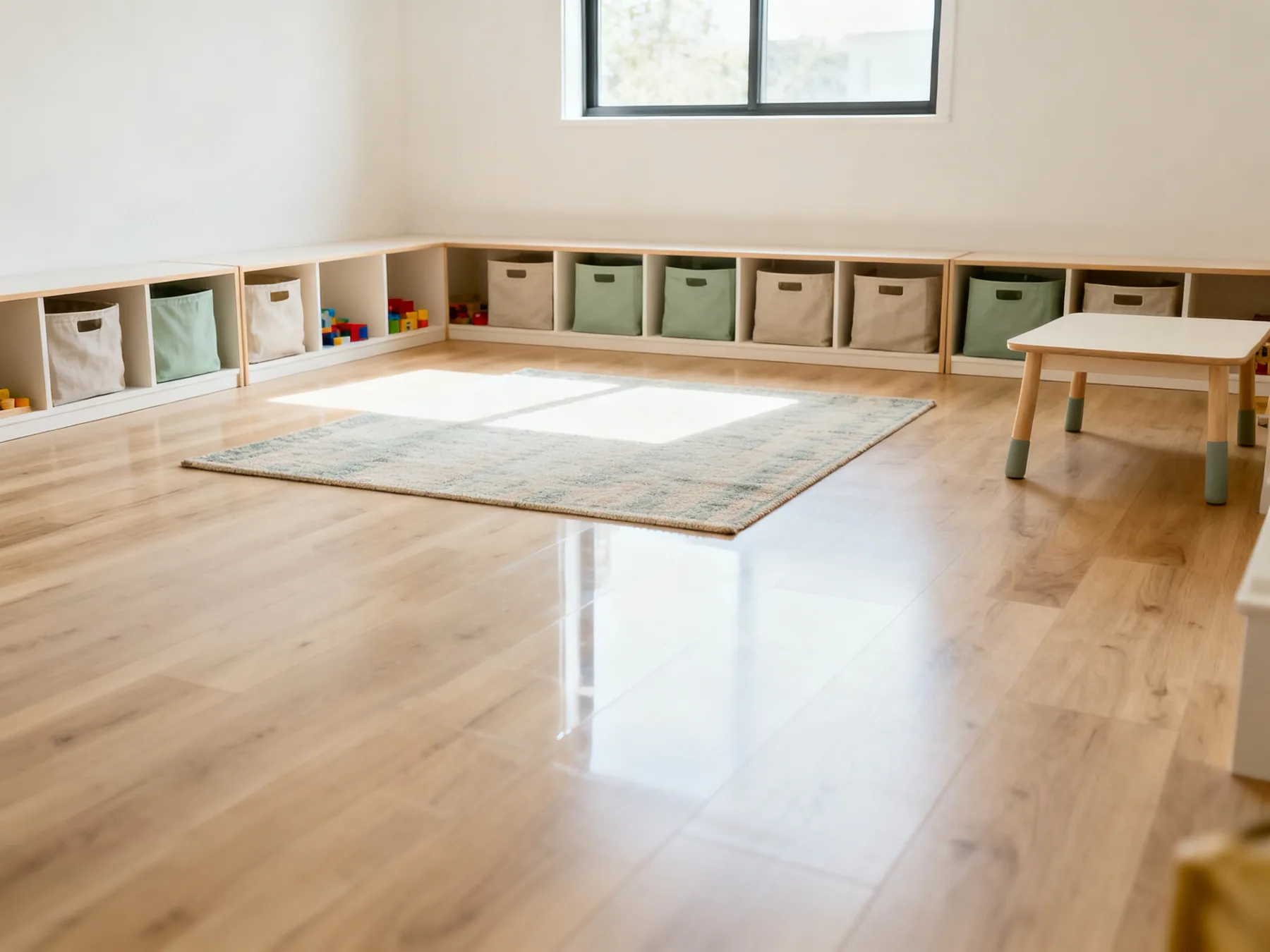
The mistake I see most often in a playroom is a good one, made for good reasons. Somebody buys a lot of storage, because there is a lot of stuff, and puts it where it fits. A unit here, a toy chest there, a table in the middle. Everything has a home and the room stops working.
What went wrong is that play happens on the floor. Building, train track, jigsaws, drawing, small figures, anything with a layout. A child needs a continuous clear area to do all of that, and a room broken up into fragments by furniture cannot provide one however much it holds.
So the rule I work to is storage round the edges, floor in the middle. Everything else in this article follows from protecting that.
Storage round the edges, floor in the middle
Before anything is bought, decide where the clear floor is going to be and defend it. In a small room that might be two square metres, and two continuous square metres is worth far more than three fragmented ones.
Low units along the walls do this well, because they hold a lot and they do not divide the space visually or physically. A tall unit in a corner is fine. What I would avoid is anything in the middle, and anything that projects far enough into the room to break the floor into separate patches.
Use low units along the walls
Around 600 to 800mm high, holding open bins. Low enough for a child to reach everything, low enough not to loom, and the top becomes a surface for a lamp or a plant rather than more storage.
The default playroom unit
Put a rug down to define the play area
A rug marks out the clear floor and makes it read as a place for something rather than as leftover space. It also makes floor play more comfortable, which means it happens more.
Push the table against a wall
A table in the middle of a playroom is the single biggest waste of floor. Against a wall it still works for drawing and puzzles, and the room keeps its centre.
Use vertical space for adult storage only
Above adult shoulder height is where the rotation boxes, spare craft supplies and the things you do not want reached go. It is genuinely useful space and none of it should hold a daily toy.
Leave one corner completely empty
Children make dens, hide, and need somewhere to be quiet. An empty corner with a cushion in it is doing a job even though it holds nothing.
Zone by activity, not by category
A shelf of neatly categorised toys looks organised and behaves badly, because a child does not go to the playroom looking for a category. They go to do something: draw, build, dress up, read.
Zoning by activity means everything needed for one thing is in one place. The drawing zone has paper, pens and a surface. The building zone has the blocks and floor next to it. The reading corner has the books and somewhere soft. That is what lets a child start an activity independently, which is the whole point of a playroom.
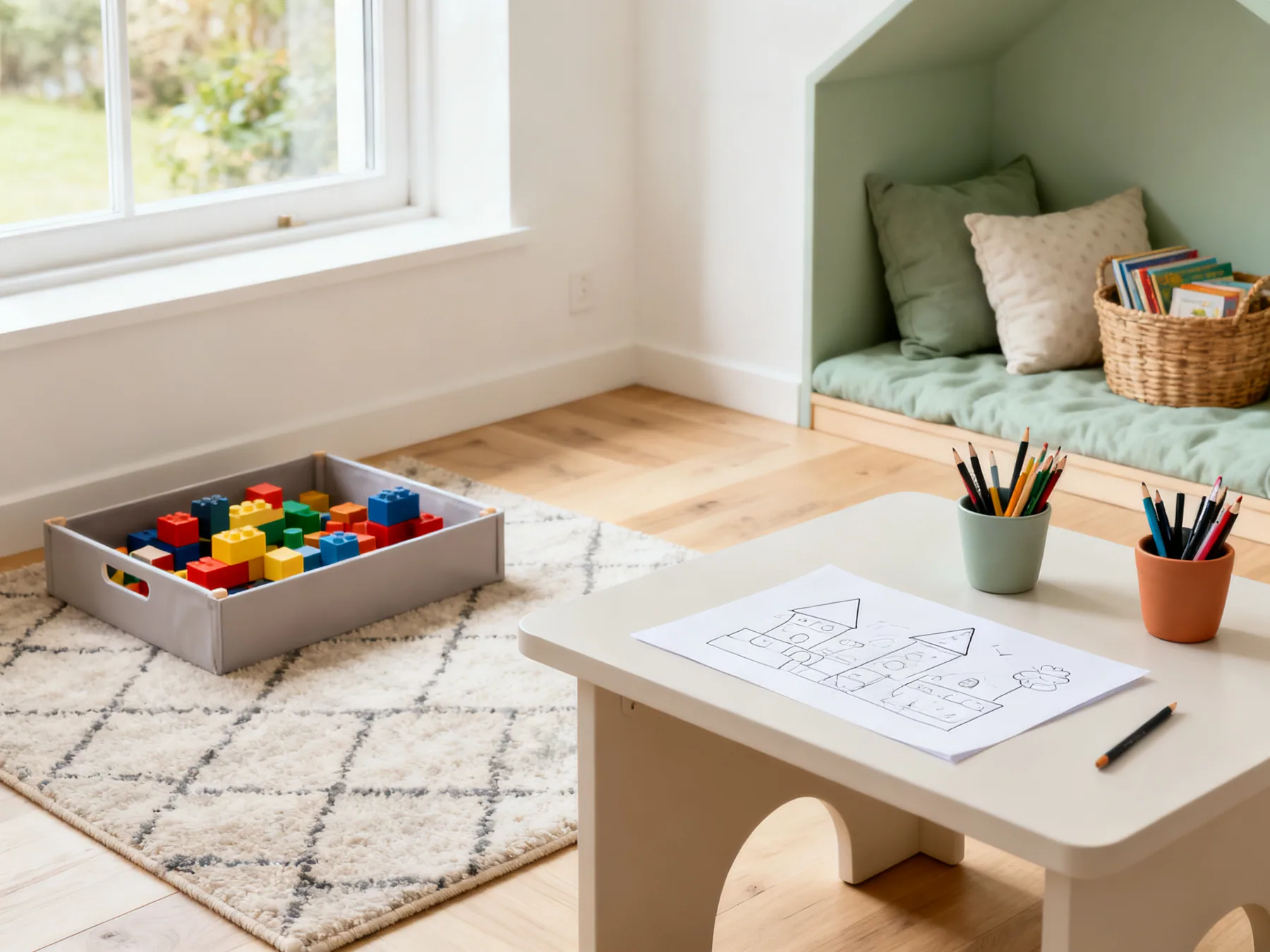
Give each activity a defined patch
It does not need walls or labels, just consistency. The blocks live here, the drawing happens there. Children learn a spatial layout very quickly and then maintain it better than an abstract system.
Keep the messy zone away from the soft one
Paint, glue and playdough on a wipeable floor near the table. Cushions, books and soft toys somewhere else entirely. Mixing them is how a rug gets ruined.
Put the noisy things furthest from the door
If the playroom adjoins a living space, the loud activities belong at the far end. Small point, and it decides whether the room actually gets used at the times you want it used.
One bin, one kind of toy
A bin with three types of toy in it gets emptied onto the floor every time, because that is the only way to find anything. One category per container turns tidying into sorting, which small children are surprisingly willing to do.
The single most useful container rule
Height, and picture labels
Two practical points that decide whether a child can use the room without an adult.
The first is height. Anything in daily use has to sit below the child's shoulder, which is roughly 750 to 900mm for a pre-schooler. Above that is adult storage. This is not about tidiness, it is about whether putting something away is physically possible for the person who took it out.
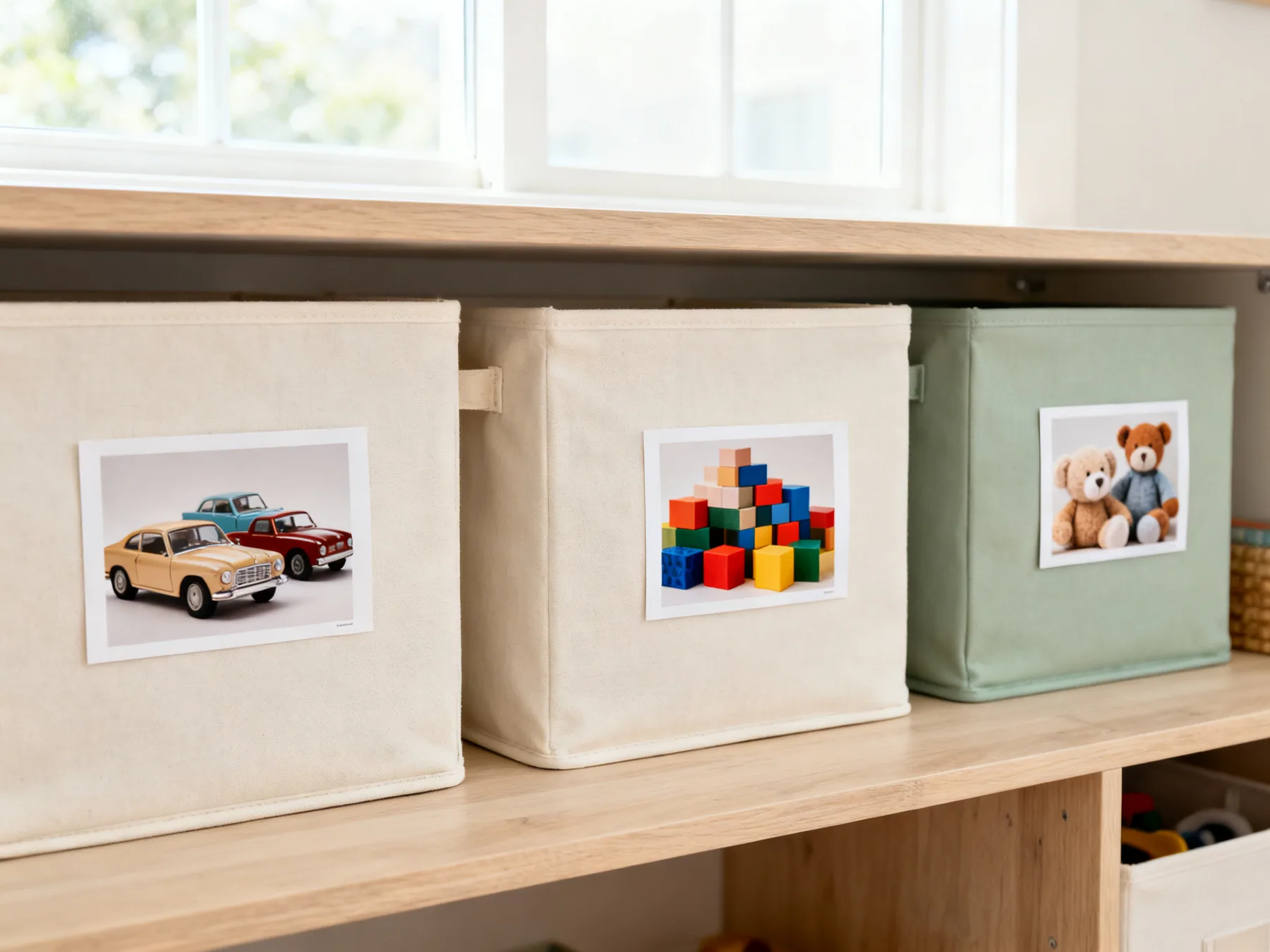
The second is labels. Word labels are for you. A photograph of what belongs in the bin, or the toy itself taped to the front, is what a three-year-old can read.
Measure your child and use that as the ceiling
Their shoulder height, not a general guideline. Then put the most-used categories at the most reachable point rather than the tidiest-looking one.
Photograph the contents for the label
Print a photo, or take a picture on your phone and stick the actual toy on the front. Both work. Word labels alongside are fine and are doing nothing for the child.
Re-photograph when the contents change
Labels drift. A bin labelled with cars that now holds dinosaurs is worse than no label, because it teaches a child that labels do not mean anything.
Use open bins, not lidded boxes, for daily toys
A lid is an extra step managed while already holding a toy, and it is reliably enough friction to stop the toy going away. Lids belong on the rotation stock up high, not on the everyday bins.
Safety, which is not a formality here
I want to be direct about this section because it is the one part of a playroom where getting it wrong has consequences beyond untidiness.
Children climb shelving. Not occasionally, and not only the ones you would expect to. A loaded unit that tips forward onto a small child is a serious injury, and furniture tip-overs are a well-documented cause of them. Anchor straps cost very little and take ten minutes.
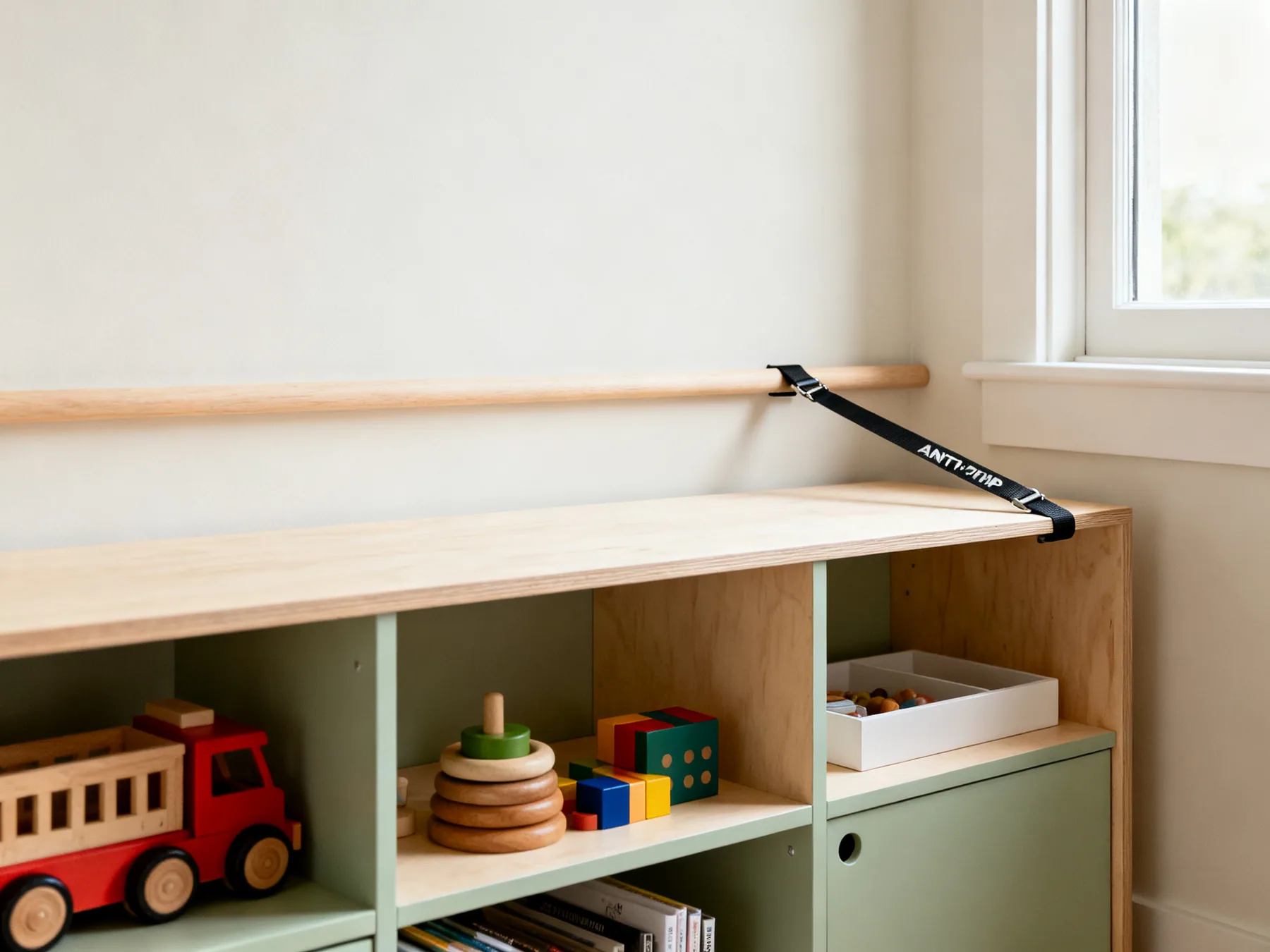
- Anchor every unit to the wall, including low ones. Low units tip too.
- Put the heaviest things on the lowest shelf so the unit stays bottom-heavy.
- Check any toy chest lid has slow-close supports, or remove the lid entirely.
- Keep small parts above the reach of any child under three, since they are a choking risk.
- Avoid glass, mirrors and sharp corners at child height.
- Keep cords, blind pulls and charging cables well out of reach and shortened.
- Check batteries, especially button cells, are in sealed compartments or stored high.
- Re-check anchor straps every few months, and after any furniture is moved.
Rotation, and the reset that keeps it working
Two habits do more for a playroom than any amount of storage. Both are about reducing what is out rather than holding more.
Rotation means boxing roughly two thirds of the toys and keeping them out of the room, swapping them every few weeks. Children play longer and more deeply with fewer options, because choosing is harder than playing, and toys returning after a month get treated as new.
The reset means five minutes at the end of the day rather than a big clear-out at the weekend. Little and often is the only rhythm children sustain, and it is what keeps the floor available tomorrow.
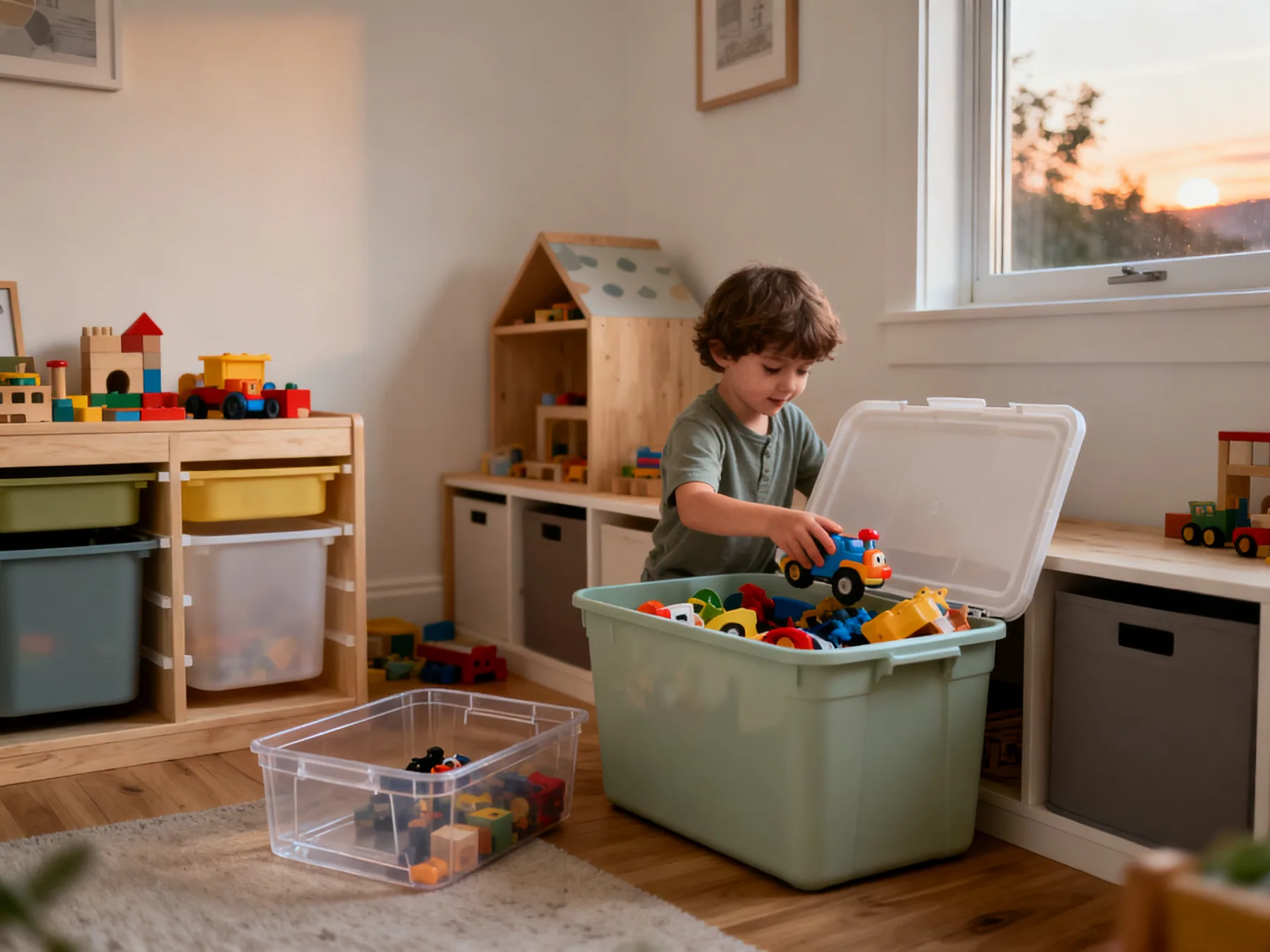
- Box around two thirds of the toys and store them above adult shoulder height.
- Swap the rotation every three or four weeks, or when interest visibly drops.
- Keep the genuinely loved things out permanently. Rotation is for the broad middle.
- Do a five-minute reset at the same point every day rather than a weekly clear-out.
- Tidy alongside them at first. Sorting into labelled bins is a game before it is a chore.
- Keep one bin permanently empty for whatever arrives next.
- Move outgrown toys into the rotation boxes rather than leaving them in the daily zone.
- Watch where toys get abandoned. That tells you where storage is missing.
Playroom storage ideas that protect the floor space: frequently asked questions
How should I arrange storage in a playroom?
Round the edges, keeping the middle of the floor clear. Play happens on the floor, so a continuous open area matters more than total shelf capacity, and a room broken into patches by furniture cannot provide one. Low units along the walls hold a lot without dividing the space, and the table belongs against a wall rather than in the centre.
How high should playroom storage be?
Anything in daily use should sit below the child's shoulder, which is roughly 750 to 900mm for a pre-schooler. Measure your own child rather than using a general figure. Everything above that height is adult storage for rotation boxes and craft supplies, and no daily toy should be up there.
How do I label playroom storage for a child who cannot read?
With photographs, or by taping the actual toy to the front of the bin. A word label tells you where something goes and tells a three-year-old nothing. Both together is fine. Re-do the label when the contents change, because a bin labelled with cars that now holds dinosaurs teaches a child that labels are meaningless.
Is playroom shelving dangerous?
It can be, and this is worth taking seriously rather than treating as a formality. Children climb shelving, including low units, and a loaded unit tipping onto a small child causes serious injury. Anchor every unit to the wall, keep the heaviest contents on the lowest shelf, and re-check the straps every few months and after moving anything.
Should playroom toys be in open bins or boxes with lids?
Open bins for everyday toys and lids only for rotation stock stored up high. A lid is an extra step a child has to manage while already holding a toy, and that friction is reliably enough to stop the toy being put away at all. Also keep one category per bin, so tidying becomes sorting rather than cramming.
How do I stop the playroom becoming overwhelming?
Rotate. Box around two thirds of the toys, store them above adult shoulder height, and swap every three or four weeks. Children play longer with fewer options out because choosing is harder than playing, and toys that come back after a month feel new. Then do a five-minute reset daily rather than a big clear-out weekly.