Hobbies & Sport
LEGO storage ideas: how I sort thousands of bricks
LEGO storage is a sorting problem, not a container problem. And below a few thousand pieces, my honest advice is not to sort it at all.
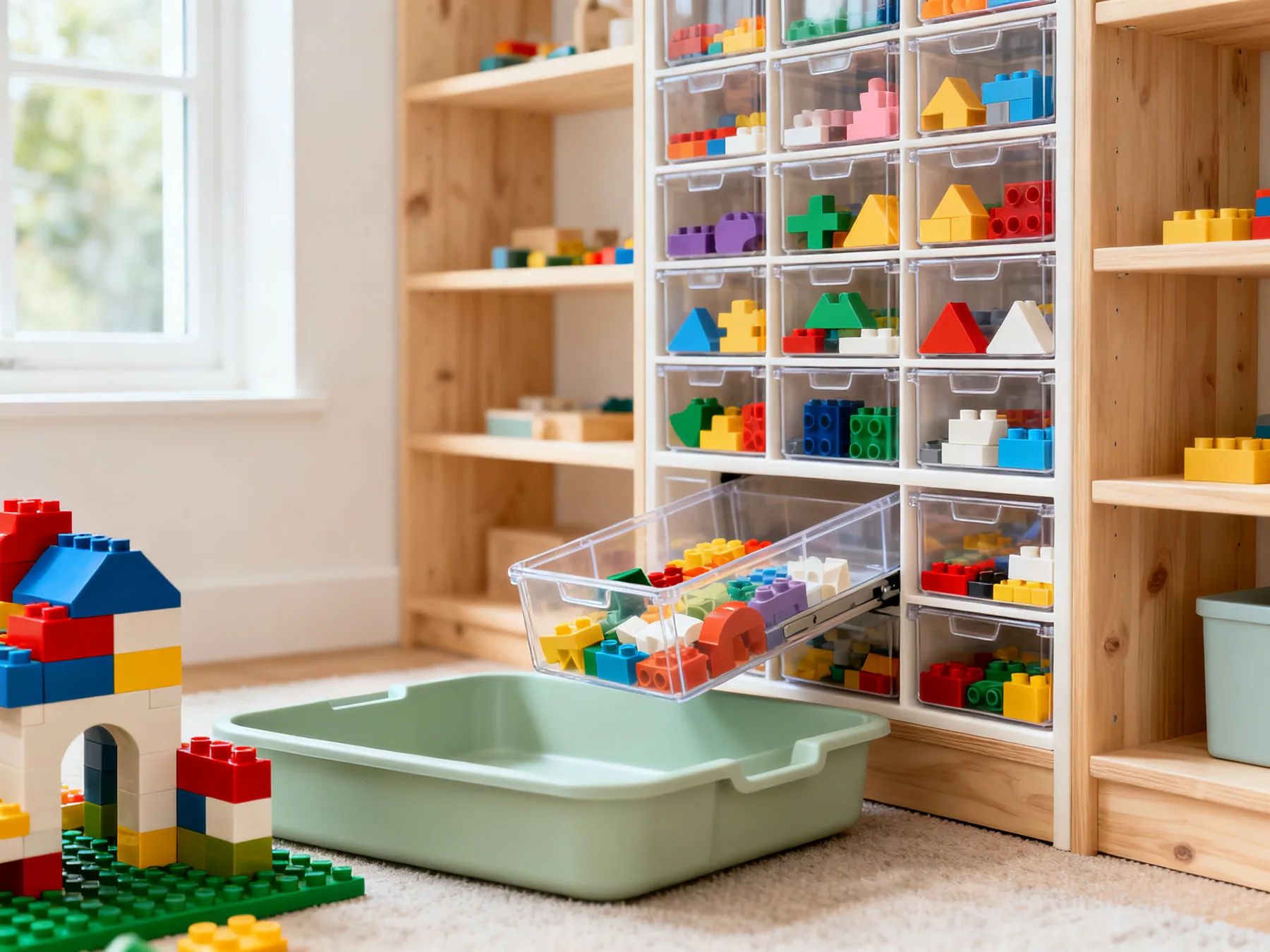
Every collection I have helped with goes through the same three stages. One tub, which works fine for a few hundred pieces. Then a growing pile of tubs, which is genuinely worse than one. Then a sorting system, at which point the collection becomes usable again.
The decision that matters is what you sort by, because it determines how a build session actually feels. Sorting by colour is intuitive and looks wonderful on a shelf. Sorting by shape is what makes building fast. Most experienced builders end up sorting by shape and accepting the shelf looks less photogenic.
Decide what you are sorting by, or whether to sort at all
This is the whole decision, and it depends on how the LEGO gets used rather than how much of it there is.
Sort by shape if it is used for free building. When you need a 1x4 plate you need that shape in whatever colour is available, and a shape-sorted system hands it to you in one reach. Sort by colour only if it is mostly display models, or the builder thinks in colour blocks first. Sort by set only if you genuinely rebuild specific sets, because it is far more work to maintain than people expect.
And if the collection is small, do not sort it. The time cost of filing outweighs the time saved finding, and I would rather tell you that than sell you drawers you do not need.
- Under 2,000 pieces: one or two large shallow bins, no sorting.
- 2,000 to 10,000: eight to fifteen broad shape families.
- Over 10,000: shape families subdivided by size, in a drawer unit.
- Keep minifigures, wheels, windows and specialty parts separate at any size. Those are what people hunt for.
- Never sort by colour and shape together unless the collection is enormous. The maintenance is brutal.
Containers, and the rule people always break
Depth is the enemy. Finding a piece means scanning a single layer, so a 100mm deep tray is searchable and a 300mm tub of exactly the same bricks is an excavation. This is the most commonly ignored rule in LEGO storage and it matters more than what the container is made of.
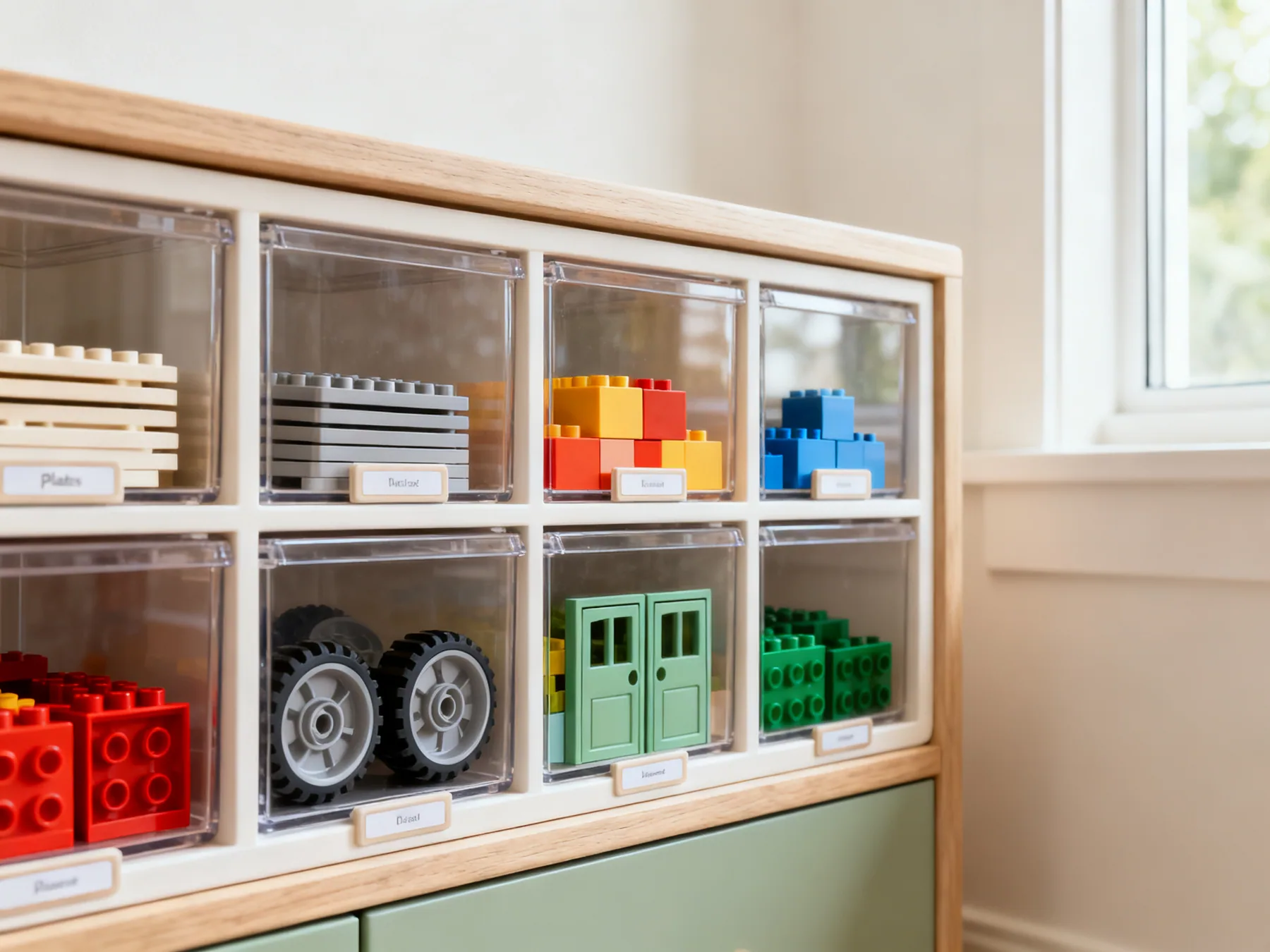
Multi-drawer craft or hardware cabinets
Small transparent drawers, the sort sold for screws and craft supplies, are the standard answer for a shape-sorted collection. You can see the contents, pull one drawer to the table, and the footprint is small. Look for removable dividers.
Shallow, wide trays rather than deep tubs
If you take one thing from this page, take this. Wide and shallow every time.
Depth is the enemy
Stackable lidded boxes for shape families
Clear boxes with clip lids, one shape family each. Label the short end rather than the lid, so labels stay readable once they are stacked.
Keep a sort-later bin
One amnesty bin for pieces nobody wants to file right now. It keeps the main system clean and can be emptied in front of the television. Without one, unsorted pieces contaminate everything.
A build tray changes the experience more than any drawer
This is the cheapest upgrade available and the one people are most surprised by. A shallow-sided tray or even a baking sheet as a build surface stops pieces migrating across the floor, and it lets an unfinished build be picked up and moved intact.
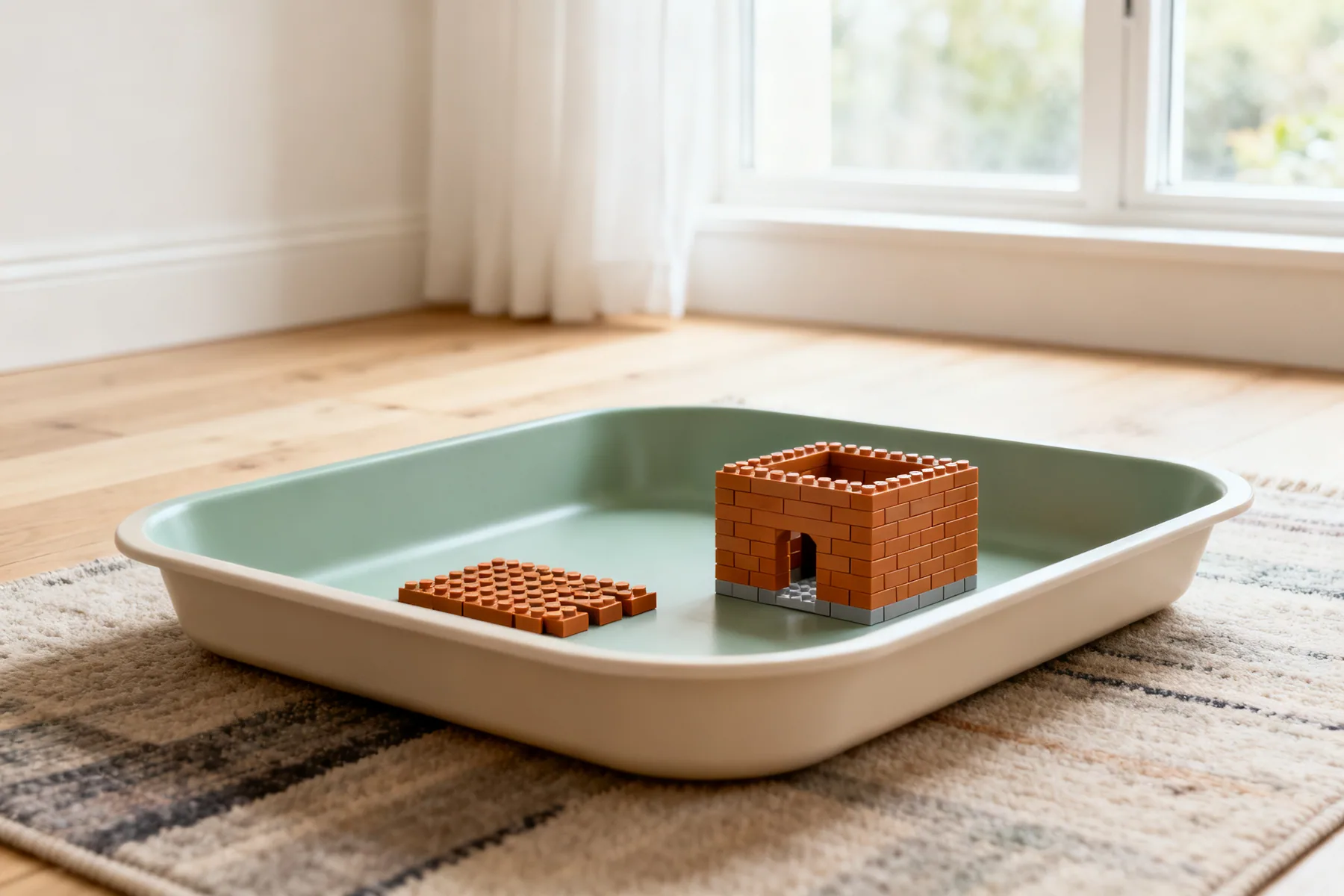
One large flat tray per builder
Big enough for the model plus a working layer of loose bricks around it. Sides only need to be 30 or 40mm.
Pull one drawer to the tray, not the whole unit
The point of a shape-sorted drawer unit is that you bring one drawer to the build rather than tipping everything out. Teach that once and the system stays intact.
Storing built models and instructions
Built models are display objects rather than storage, and the thing that damages them is not handling, it is sunlight and dust.
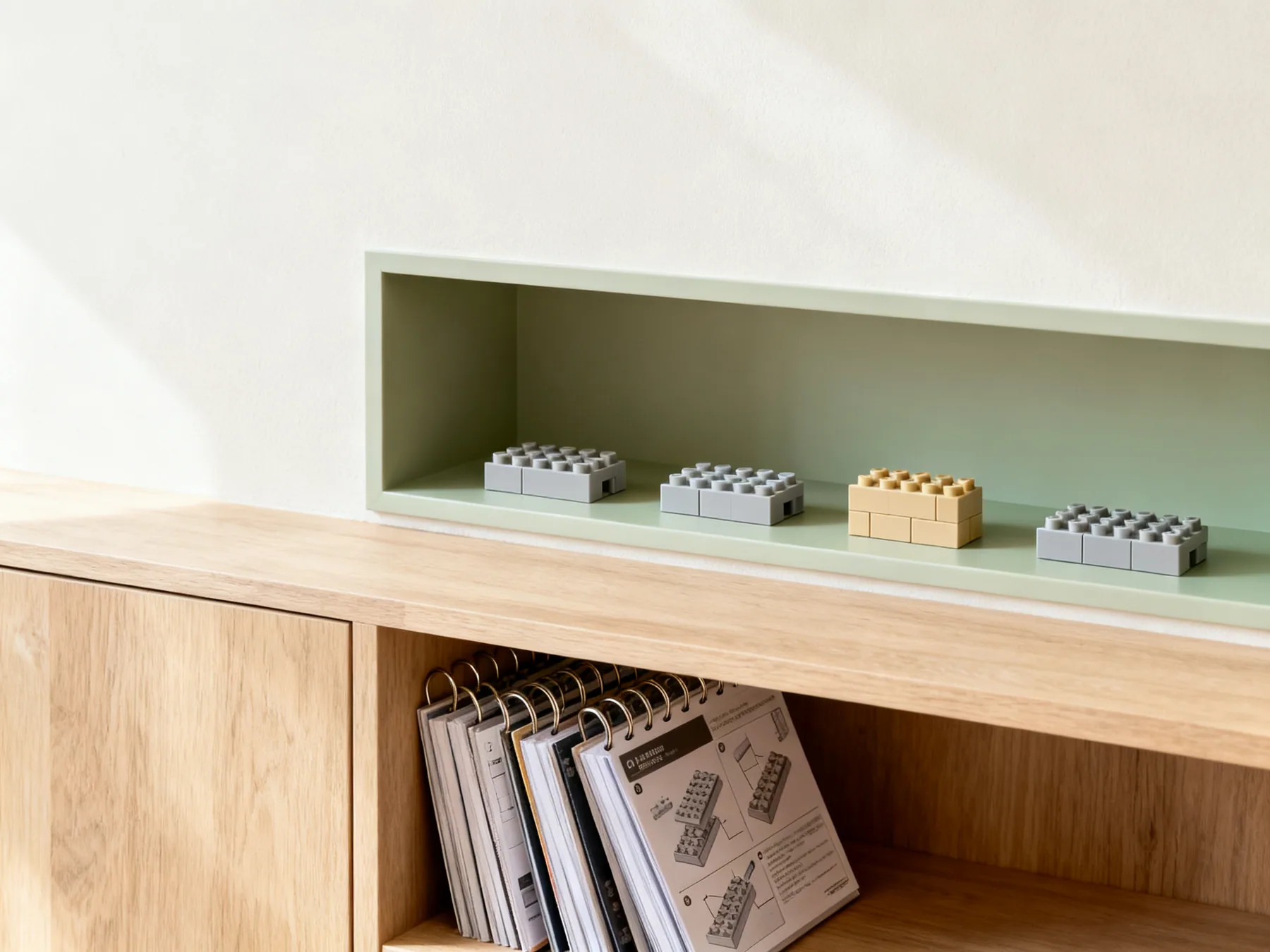
Shallow open shelves, away from windows
About 200 to 250mm deep takes most sets. Keep them off a wall with direct sun, because UV yellows white and light grey ABS over a few years and there is no reliable way back.
UV is what yellows old bricks
An enclosed case for anything intricate
Dust is the real enemy of a built model, and cleaning an intricate one is genuinely difficult. A case is worth it for the sets you care about.
Bag dismantled sets with their instructions
For anyone who rebuilds, bag each set with its booklet stored flat. A set mixed into a general pile stops being a set, and that is usually the more valuable thing lost.
Ring binders with punched pockets for booklets
Instruction booklets crease and tear stored loose. Punched pockets ordered by set number take almost no space and protect resale value.
Making a system a child will actually use
This is where most LEGO storage fails, and it fails quietly. A system that needs accurate sorting to put away will not be used accurately, and then you have a sorting system full of the wrong pieces, which is worse than a bin.
So I design for the tidy-up, not the build. If putting it away takes more than about five minutes, it will not happen.
- Aim for tidy-up in under five minutes.
- Use categories a child can judge instantly: flat pieces, big blocks, wheels and doors.
- Put pictures on the labels, not just words, for pre-readers.
- Keep containers at child height on open shelving rather than behind doors.
- Accept some misfiling. A system that degrades gracefully beats one that has to be perfect.
- Keep small pieces and sharp specialty parts out of reach of under-threes. LEGO is a choking hazard.
LEGO storage ideas: frequently asked questions
Should I sort LEGO by colour or by shape?
By shape, if the LEGO is used for building. When you need a specific piece you almost always need a shape in whatever colour is available, so shape-sorting finds it in one reach. Sort by colour only if it is mainly for display models or a colour-block build style. It looks better on a shelf and is slower to build from.
What is the best container for LEGO storage?
Shallow and wide beats deep and narrow, because you find pieces by scanning one layer rather than digging. Small transparent multi-drawer cabinets, the type sold for screws and craft supplies, are the standard choice for a shape-sorted collection, with a large flat tray as the build surface.
How should I store a small LEGO collection?
Do not sort it. Under about 2,000 pieces one or two large shallow bins genuinely beat a sorting system, because the time cost of filing outweighs the time saved finding. Keep minifigures and wheels separate, since those are the pieces people actually hunt for.
How do I stop LEGO turning yellow?
Keep it out of direct sunlight. UV is what yellows white and light grey ABS bricks, and it is not reversible in any reliable way. Store and display away from windows, and use an enclosed case for anything you care about long term.
How do I store built LEGO sets I want to keep?
On shallow open shelves out of sunlight, or in an enclosed case if they are intricate, since dust is very hard to remove from a built model. If you would rather dismantle them, bag each set separately with its instruction booklet stored flat, because a set mixed into a general pile stops being a set.
How do I get children to put LEGO away properly?
Design for the tidy-up rather than the build. Keep it to broad categories a child can judge instantly, use picture labels for pre-readers, keep containers at child height on open shelves, and aim for the whole job taking under five minutes. Expect some misfiling and pick a system that still works when only half followed.