Room Storage
Kitchen storage ideas: how I get more out of the cabinets you have
Most kitchens I look at do not need more cabinets. They need the ones they have divided properly, because a deep fixed shelf wastes about half the space it appears to offer.
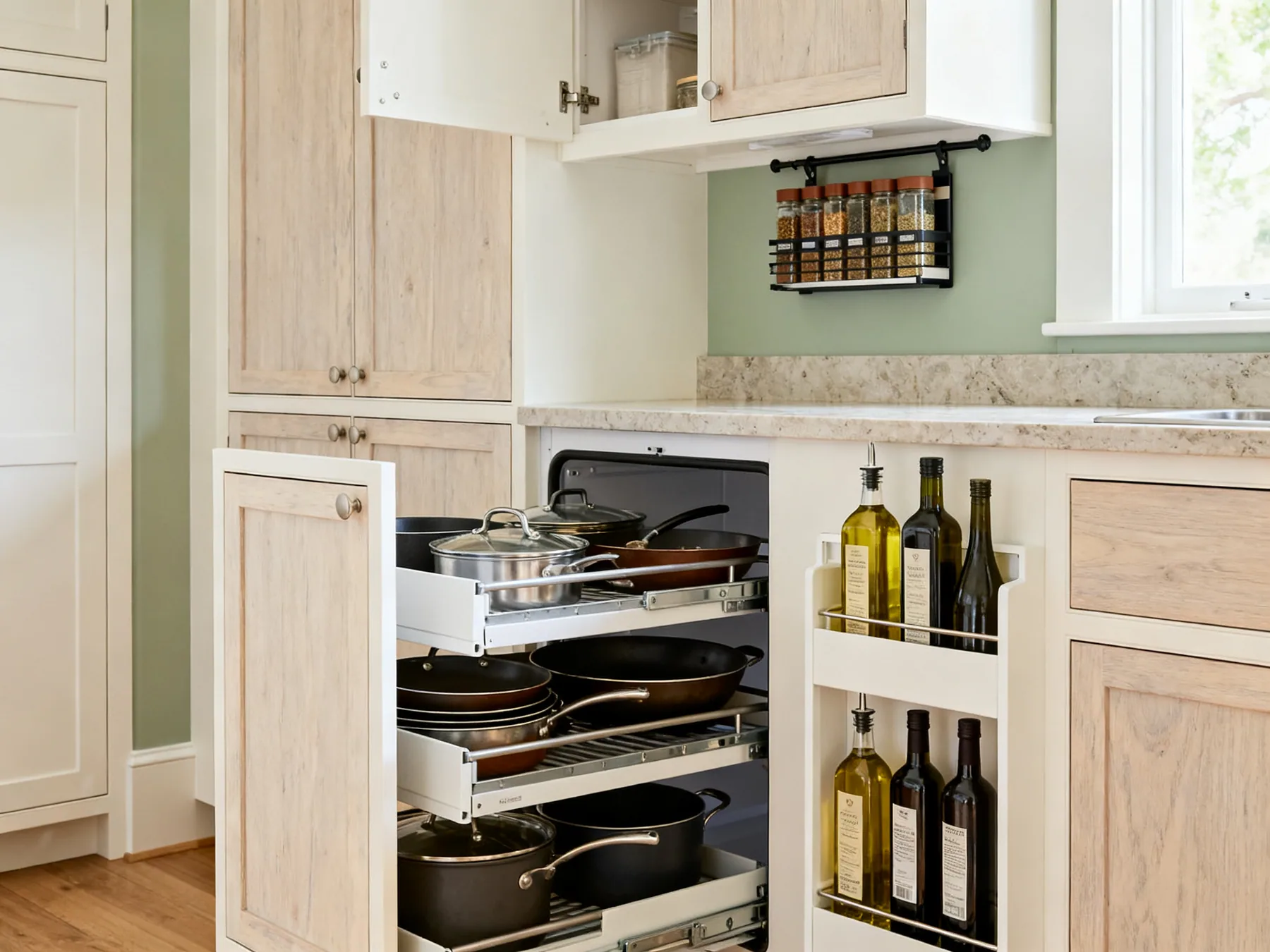
Here is the number that explains most kitchen storage problems. A standard base cabinet is about 600mm deep, but the usable depth of a fixed shelf is roughly 300mm, because anything behind the front row is invisible and effectively gone. Every deep cabinet in your kitchen is running at about half capacity right now.
That is why I start by converting depth rather than adding cupboards. Almost everything below is a way of turning that dead back half into space you can actually reach, and none of it requires a new kitchen.
Empty one cabinet before you buy anything
I ask people to do this first and almost nobody wants to. Empty a single cabinet completely onto the worktop and sort it into three piles: used daily, used monthly, used once or twice a year.
What comes out of that exercise is always the same. Something like two thirds of what was occupying prime cabinet space belongs in the third pile. The fondue set is sitting on the shelf your everyday plates should have. That one sort frees more space than any product you could buy, and it tells you what you actually need to buy afterwards.
- Empty the cabinet completely. Do not try to sort in place, it does not work.
- Sort into daily, monthly and yearly piles.
- Move the yearly pile out of the working part of the kitchen entirely.
- Reload with daily items at the front, between hip and eye height.
- Whatever still has no sensible home is your real shopping list.
Fix the dead back half of every deep cabinet
This is where the biggest gain is and it is the change I recommend most often. A base cabinet with two fixed shelves gives you four square feet of shelf and about two you can see and reach.
Swap fixed shelves for pull-out trays
A pull-out brings the back of the cabinet to you, turning 600mm of depth into 600mm of usable depth. Retrofit kits sit on the existing cabinet floor and need no surgery. Check the internal clear width first, because the runners typically eat about 25mm between them.
Biggest single gain in most kitchens
Use a two-tier pull-out for tall bottles
Oils, vinegars and sprays are tall and thin, which wastes all the air above them on a normal shelf. A two-tier pull-out doubles the count in the same footprint and keeps labels facing forward, so you stop buying a third bottle of something you already own twice.
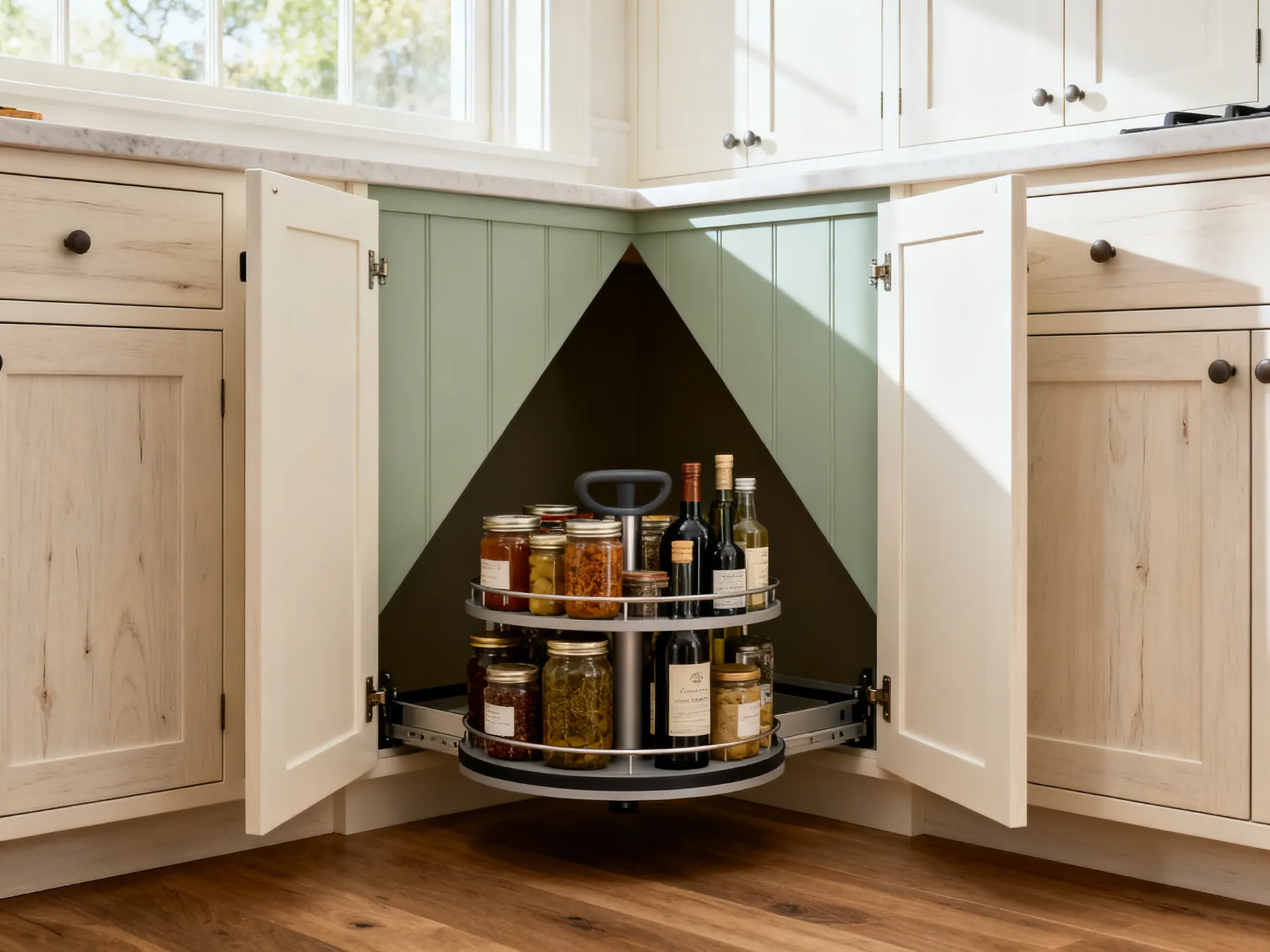
Fit a carousel in the blind corner
Blind corner cabinets are the worst storage in any kitchen: a deep triangular void that swallows whatever gets pushed into it. A rotating carousel or a magic corner mechanism makes the whole volume addressable, and it is the one kitchen fitting I think is genuinely worth paying proper money for.
Add under-shelf baskets for the half level
Wire baskets that hook over an existing shelf edge claim the unused air between that shelf and whatever is above it. A few pounds each, no tools, ideal for tea towels, foil, cling film and small packets.
Renter friendly
Pots and pans: on edge, one slot each
Pans are heavy, awkward and nest badly. Stacking them works spatially and fails in practice, because reaching the fourth pan means lifting three. That is why stacked pans end up living permanently on the hob.
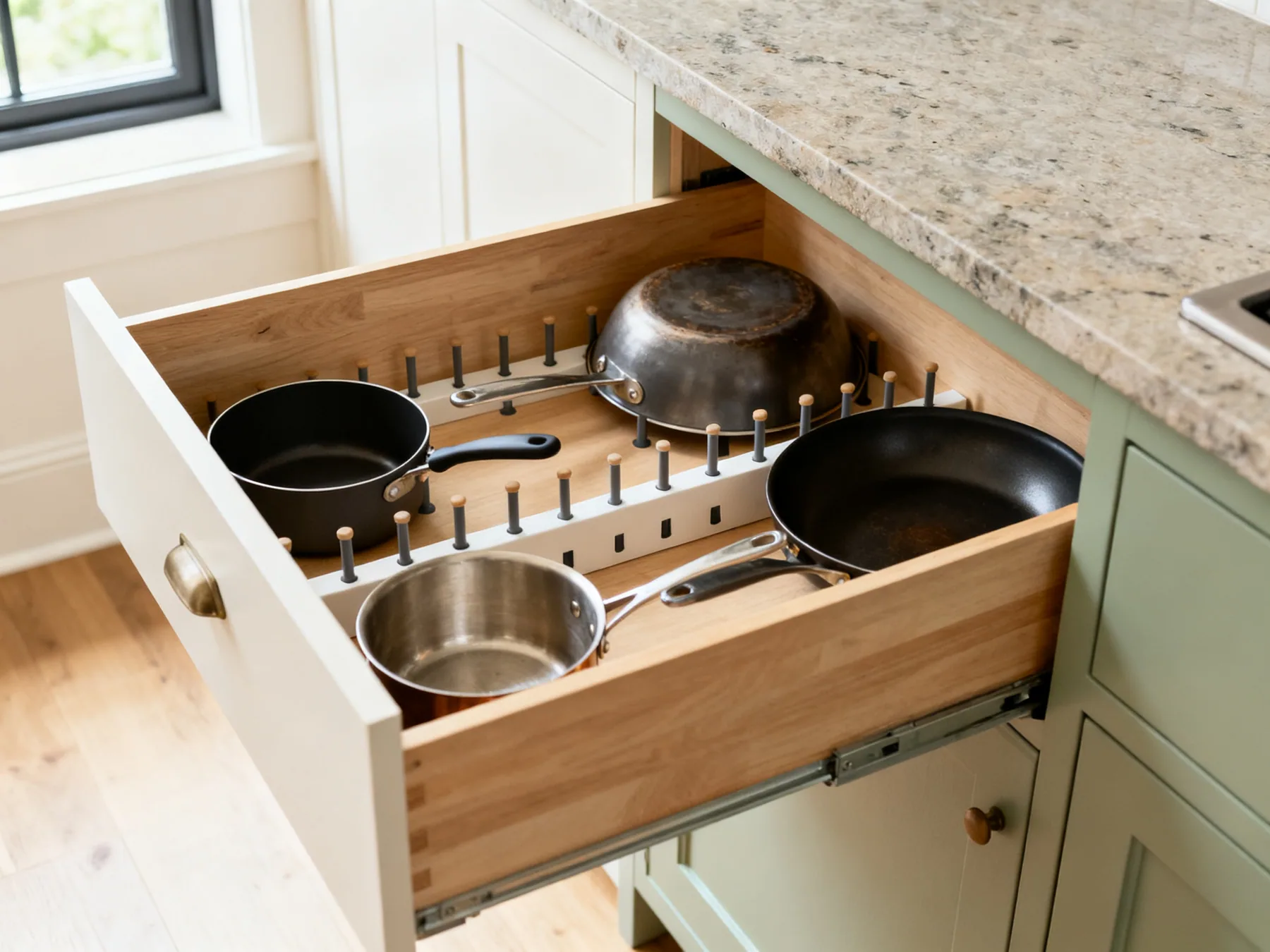
Stand pans on edge in a divided deep drawer
Adjustable peg dividers give each pan its own slot. You lift exactly one, and the drawer holds more than the equivalent stack because you are using its full height rather than just its floor.
Give lids their own vertical rack
Lids are the single reason pan cabinets never stay tidy. A vertical rack on the inside of the cabinet door, or a narrow divided section in the drawer, sorts it permanently. Sort them by diameter and the matching game disappears.
Hang pans on a rail if you have the wall
A rail of butcher hooks puts pans one motion from the hob and empties a whole cabinet. Fix into studs or masonry, never plasterboard alone, because a full set of cast iron is a serious load. Best for cooks who use the same three pans constantly.
Drawers, and the measurement people get wrong
A drawer without dividers is a box that reshuffles its contents every time it opens. Dividers are cheap and they are the difference between a utensil drawer and a utensil pile.
The mistake I see constantly is buying an insert without measuring the clear height. Plenty of inserts are sized for a 500mm cabinet and will not clear a shallower drawer or the underside of the worktop.
Measure internal length, width and clear height
All three, before you buy. Expandable spring-loaded dividers sidestep the problem entirely if you would rather not measure.
Run cutlery trays front to back in a wide drawer
In anything wider than 600mm, running trays front to back gives you more, narrower lanes and stops long utensils jamming across the opening.
Dock knives in the drawer rather than a block
Loose knives dull their edges against each other and are genuinely unpleasant to reach into. An in-drawer knife dock holds each blade separately and keeps the worktop clear, which is the real advantage over a countertop block.
Give one shallow drawer to flat things
Chopping boards, baking sheets, cooling racks and trays all fail in stacks and succeed on edge. One shallow drawer with vertical dividers absorbs the entire category.
Small kitchens: go up and use the doors
When the floor and the cabinets are both fixed, what is left is the walls, the backs of the doors, and the gap above the wall units. In most small kitchens all three are completely unused.
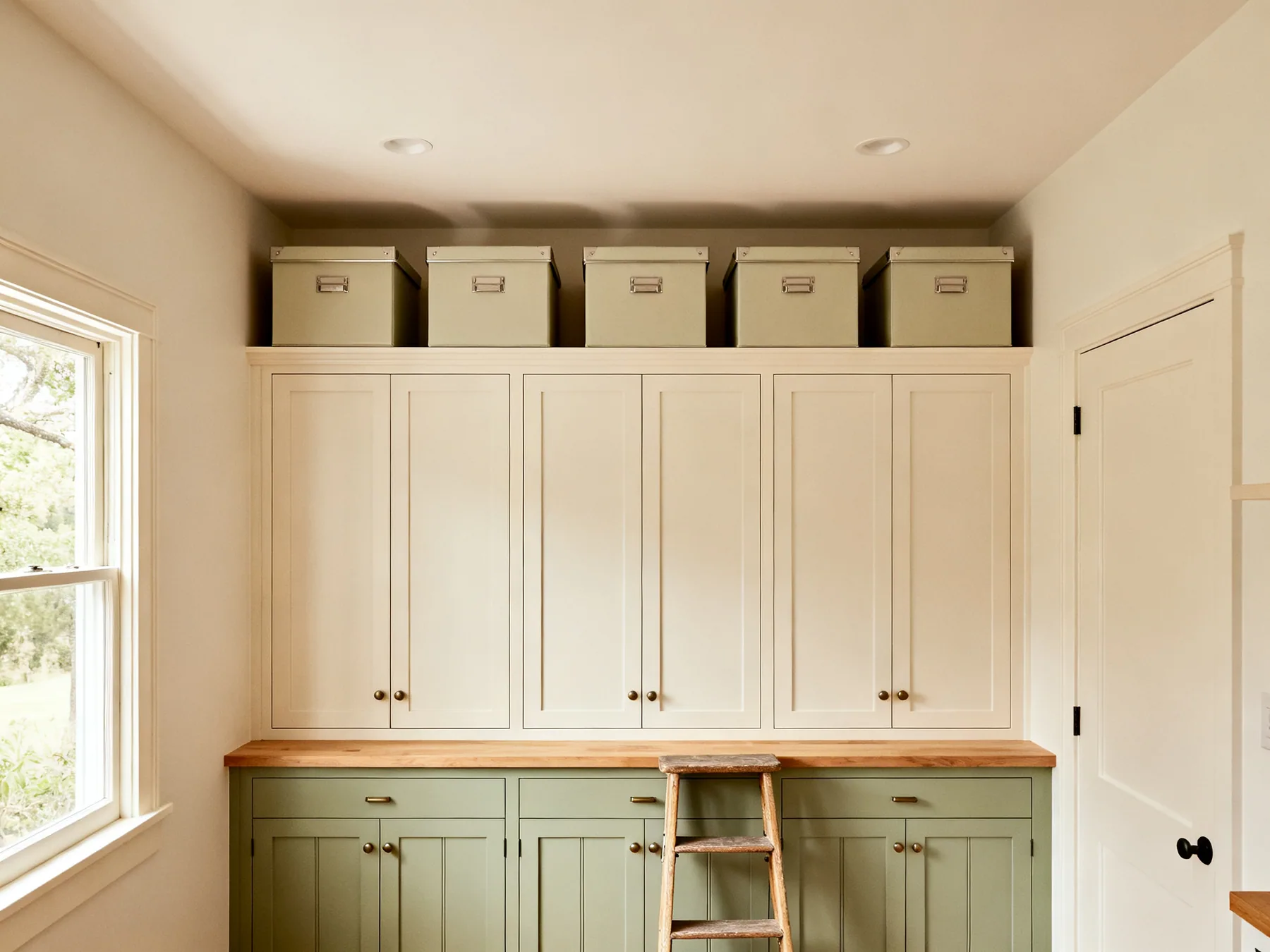
Claim the space above the wall cabinets
The 300 to 450mm between the cabinet tops and the ceiling is prime long-term storage. Matching baskets or lidded boxes read as deliberate rather than cluttered. You will need a step stool, which is exactly right for things you use once a year.
Use the inside of every cabinet door
Adhesive or screw-fixed racks on the door interiors hold spice jars, wraps, measuring spoons and cloths. Check the door clears the shelf edges before fixing, because 40mm of rack needs 40mm of clearance.
Put a slim rolling cart in any gap over 150mm
A three-tier cart slots between a fridge and a wall and rolls out for access. It is the best answer to the awkward vertical gap appliances always leave.
Fit a magnetic strip for knives
Frees a drawer and puts blades where you use them. Fix to a wall or the side of a wall cabinet, well out of reach of children.
Food and pantry: if you cannot see it, you will buy it again
Food storage has one requirement the rest of the kitchen does not. You have to be able to see what you own, or you will buy it twice. Every pantry system is really a visibility system.
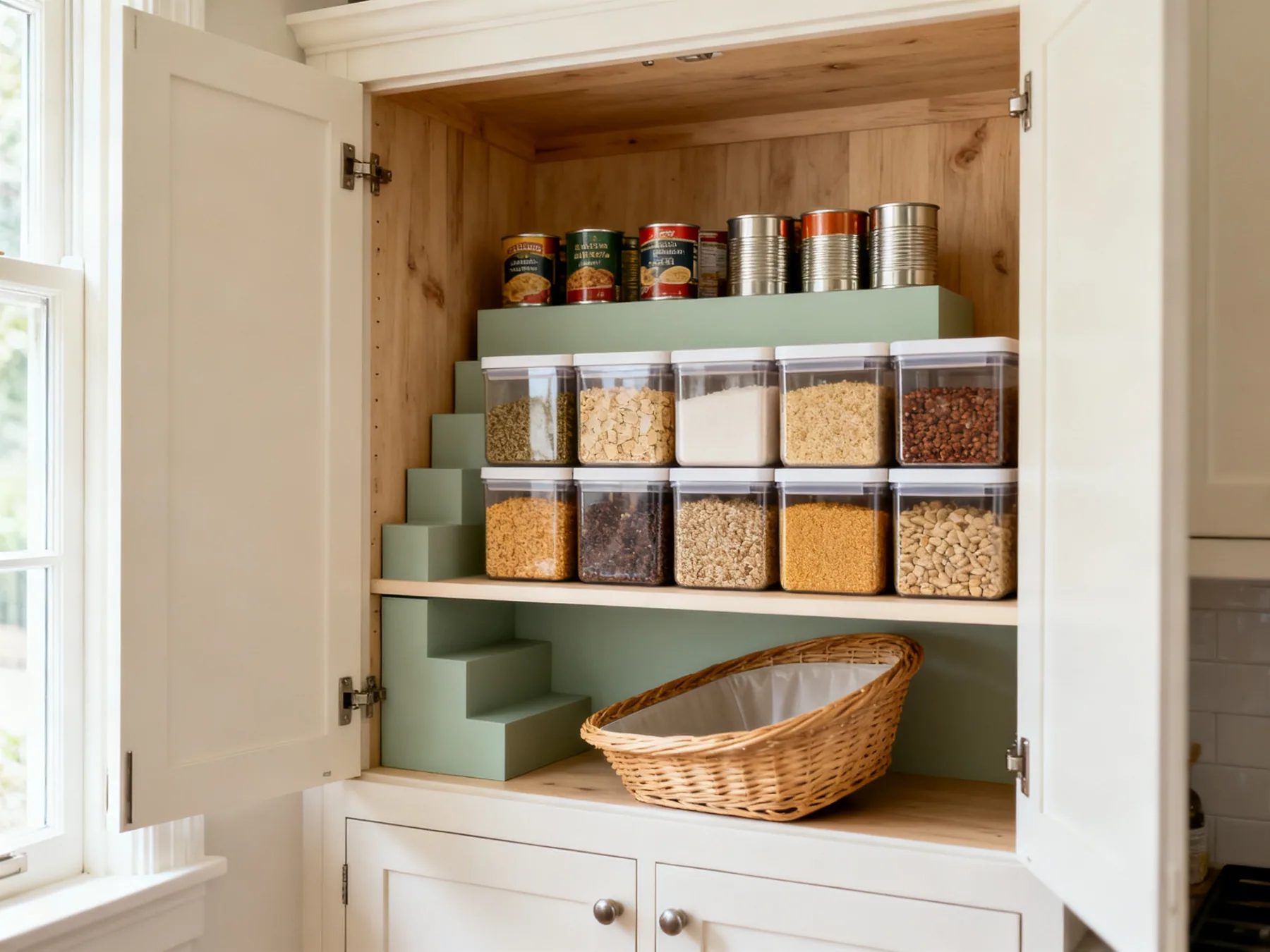
Decant dry goods into square containers
Square and rectangular containers tessellate. Round ones waste roughly a fifth of the shelf. Decanting also makes stock levels obvious at a glance. Label with the contents and the date you opened it.
Use tiered risers for tins and jars
A stepped riser makes the back row visible instead of hidden. This is the single fix for the cupboard containing four opened jars of the same spice.
Group by meal, not by food type
A basket holding pasta, sauce and parmesan together beats separate pasta, sauce and cheese zones for anyone cooking on a weekday. Group the way you cook, not the way a supermarket is laid out.
Keep a front-facing use-first bin
One shallow basket at eye height for anything approaching its date. It cuts food waste noticeably and takes no extra space.
Kitchen storage ideas: frequently asked questions
How do I get more storage in a kitchen without adding cabinets?
Convert the depth you already have. Replacing fixed shelves with pull-outs, standing flat items on edge and using the inside of cabinet doors typically recovers 30 to 50 percent more usable space from the same cabinets. After that, claim the wall and the gap above the wall units.
Are drawers or shelves better for kitchen base cabinets?
Drawers, in almost every case. A drawer shows its whole contents from above and loses nothing at the back, whereas a fixed shelf in a 600mm cabinet has around 300mm that is effectively unreachable. Shelves only win for very tall items and for keeping costs down.
What is the best way to store pots and pans?
On edge in a deep drawer with adjustable dividers, so each pan has its own slot and you never lift one to reach another. If you have no drawer space, a wall rail fixed into studs or masonry is the next best option and puts pans within reach of the hob.
How high can I store things in a kitchen?
Anything above about 1.8m needs a step stool, so reserve that zone for items used once or twice a year. Keep the band between hip and eye height, roughly 750mm to 1.6m, for everything you touch daily, and put heavy items low so you are never lifting weight above shoulder height.
Should I decant food into containers or keep the original packaging?
Decant anything you buy repeatedly and store long term: flour, rice, pasta, cereal, pet food. Square containers pack flush and make stock visible. Keep original packaging where you rely on the cooking instructions, or cut that panel out and drop it in the container.
What should I do with a blind corner cabinet?
Fit a rotating carousel or a pull-out magic corner mechanism. A blind corner is a deep triangular void that swallows anything pushed into it, and it is the one place in a kitchen where the specialist fitting is genuinely worth the money rather than a nice-to-have.