Room Storage
Small kitchen storage ideas that give you your counter back
In a small kitchen, clear counter is not tidiness. It is the space you cook in, and every object left out is taken from it.
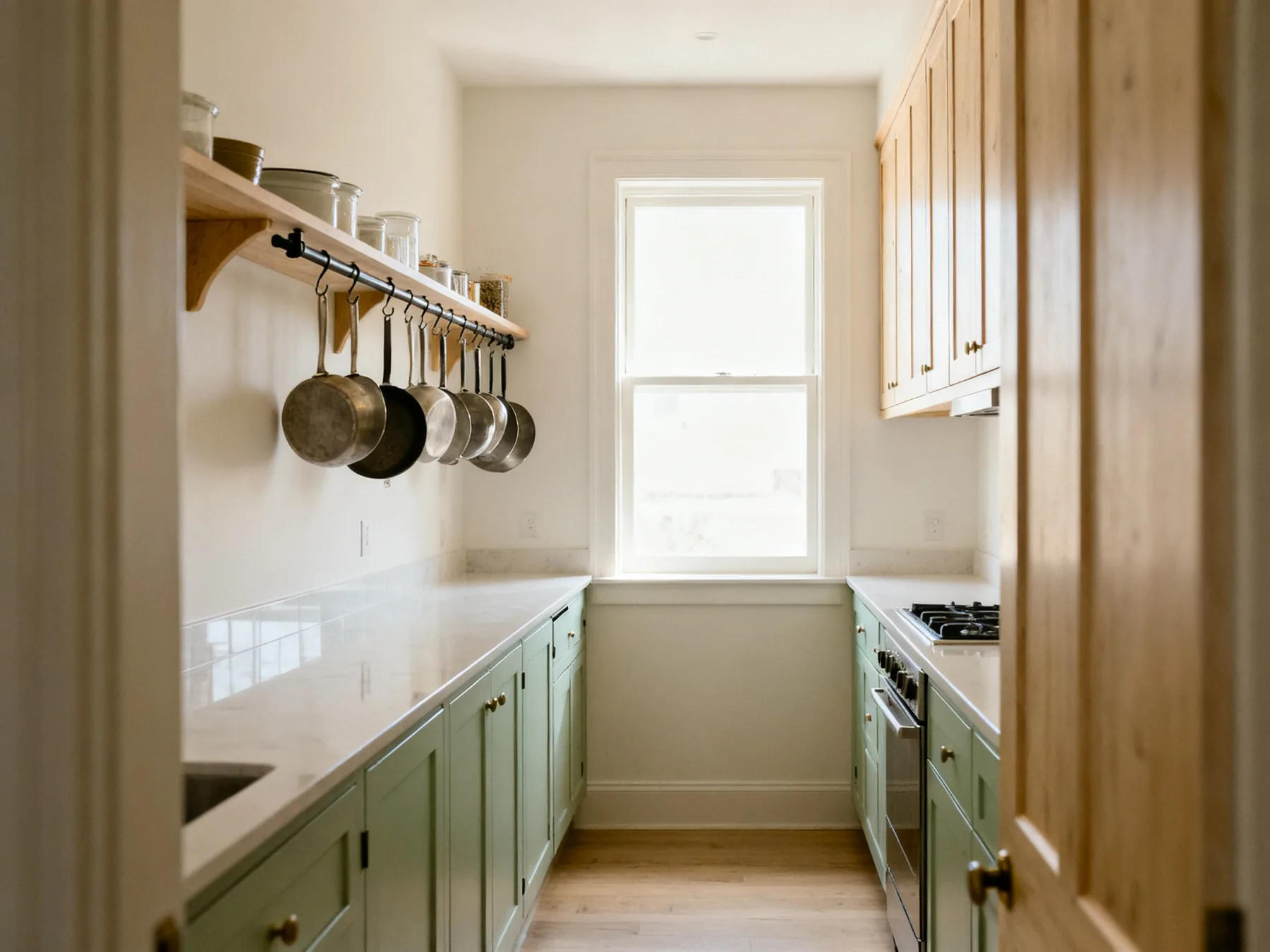
The complaint I hear about small kitchens is almost always about storage, and the thing that actually makes them hard to use is counter. Those sound like separate problems and they are the same problem. Anything that has no home ends up on the worktop, and in a kitchen with two metres of worktop, six homeless objects have taken a third of your working area.
So when I plan a small kitchen I am not really trying to fit more in. I am trying to get things off the counter and into places that already exist but are not being used: the band above the wall cabinets, the dead depth in the corner unit, the wall behind the splashback, and the inside of every door.
That reframing matters, because it changes what you buy. A counter-top storage caddy makes a small kitchen worse. It solves a tidiness problem by consuming the resource that was actually scarce.
Take the cabinets to the ceiling
Stand back and look at the gap between the top of your wall units and the ceiling. In most kitchens it is somewhere between 300 and 500mm, it runs the full length of the run, and it is holding a decorative jug and a layer of grease.
That band is the single largest piece of unused space in a small kitchen. Boxing it in, or fitting a second shallow tier of doors, gives you a whole extra shelf the depth of the cabinets. It is awkward to reach, which is exactly right for the things you use twice a year and which are currently taking up a shelf you need daily.
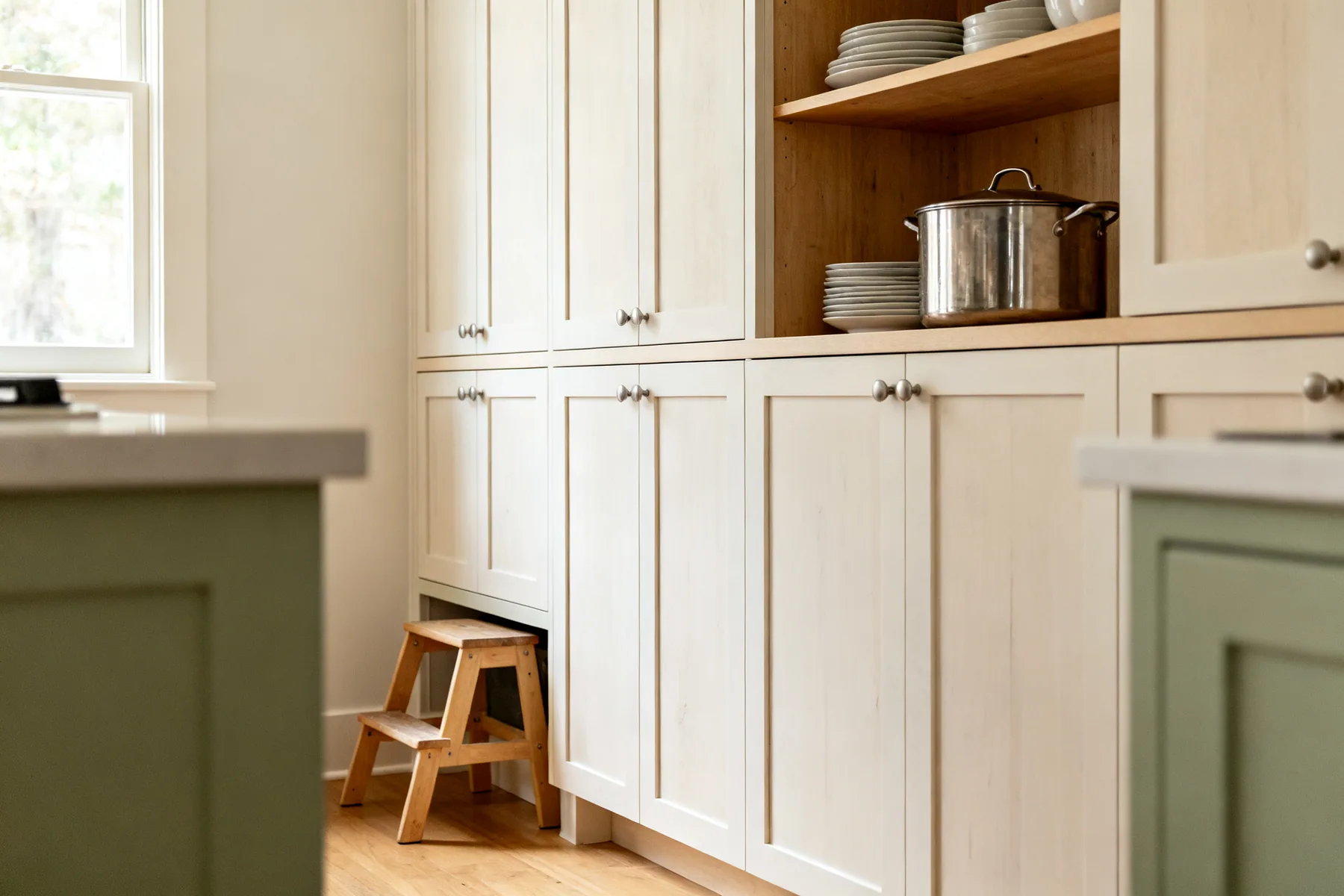
Fit a second tier of doors above the wall units
Matching the existing doors makes it read as one run rather than an afterthought. Put the roasting tin, the stock pot, the serving dishes and the Christmas things up there and you free real estate at working height.
Usually the biggest single gain available
If you cannot fit doors, at least use the top
Where cabinetry is not an option, matching lidded boxes along the top of the units work well and keep dust off. Matching matters here, because six mismatched containers on top of a cabinet run read as clutter in a way that one repeated shape does not.
Keep a step stool in the kitchen
High storage only works if reaching it is not a project. A slim folding stool that lives against the end of the run makes the top tier genuinely usable rather than theoretically usable.
Do not put daily items up there
The rule is effort matched to frequency. If you reach for it weekly it should not need a stool, and if you find yourself leaving the stool out permanently, something in the wrong place has gone up high.
The corner cabinet, where the space actually goes
A standard corner base cabinet is the worst-performing storage in any kitchen. The opening is on one face, the cabinet extends away from it in two directions, and there is a zone at the back you can neither see nor reach without emptying the front of it onto the floor.
In a small kitchen that cabinet might be a fifth of your base storage, and you are probably using half of it. This is the fix I recommend most often when someone has a little budget and wants it spent well.
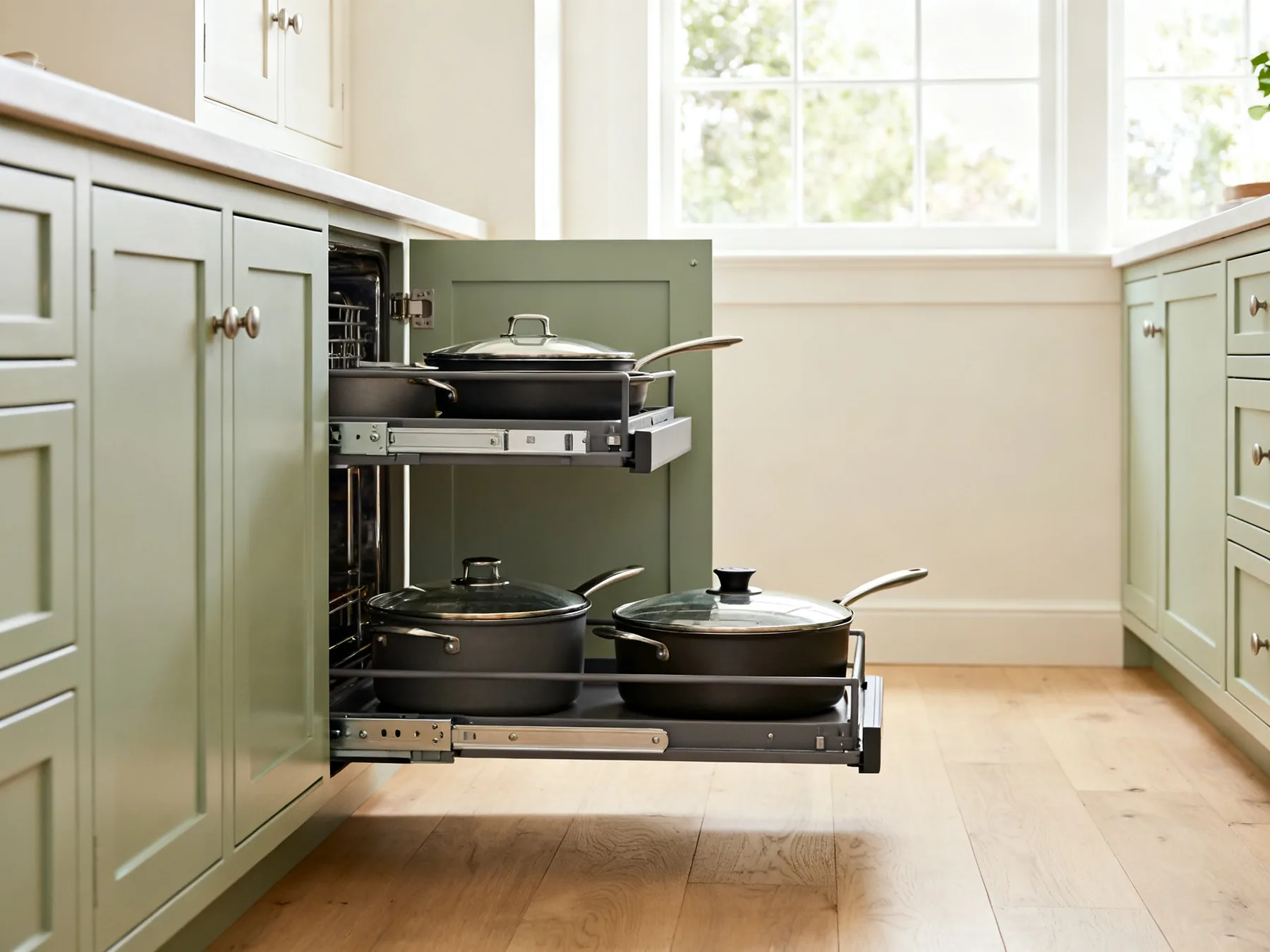
Retrofit a corner pull-out
A swing-out or carousel mechanism brings the whole contents of the corner out into the room instead of making you reach in. They can be fitted to an existing cabinet in most cases, and the difference in usable volume is dramatic rather than marginal.
Measure the opening before ordering
Failing that, store one thing in the deep zone
If a mechanism is not happening, put a single large item in the unreachable part, something you take out as a whole, like a stack of mixing bowls or a bread machine. What kills that space is storing many small things in it.
Never put daily items in a corner cabinet
It is the highest-effort access in the kitchen. Pans you use every day belong in a drawer near the hob, and the corner takes the things you reach for monthly.
Drawers, and why they beat cupboards for anything heavy
If you are replacing base units in a small kitchen, I would put drawers almost everywhere and cupboards almost nowhere. The reason is simple mechanics: a drawer brings its contents out to you, while a cupboard makes you kneel down and reach past the front row into the dark.
With pans and heavy items that difference is not about convenience. It is what determines whether the back half of the cabinet gets used at all.
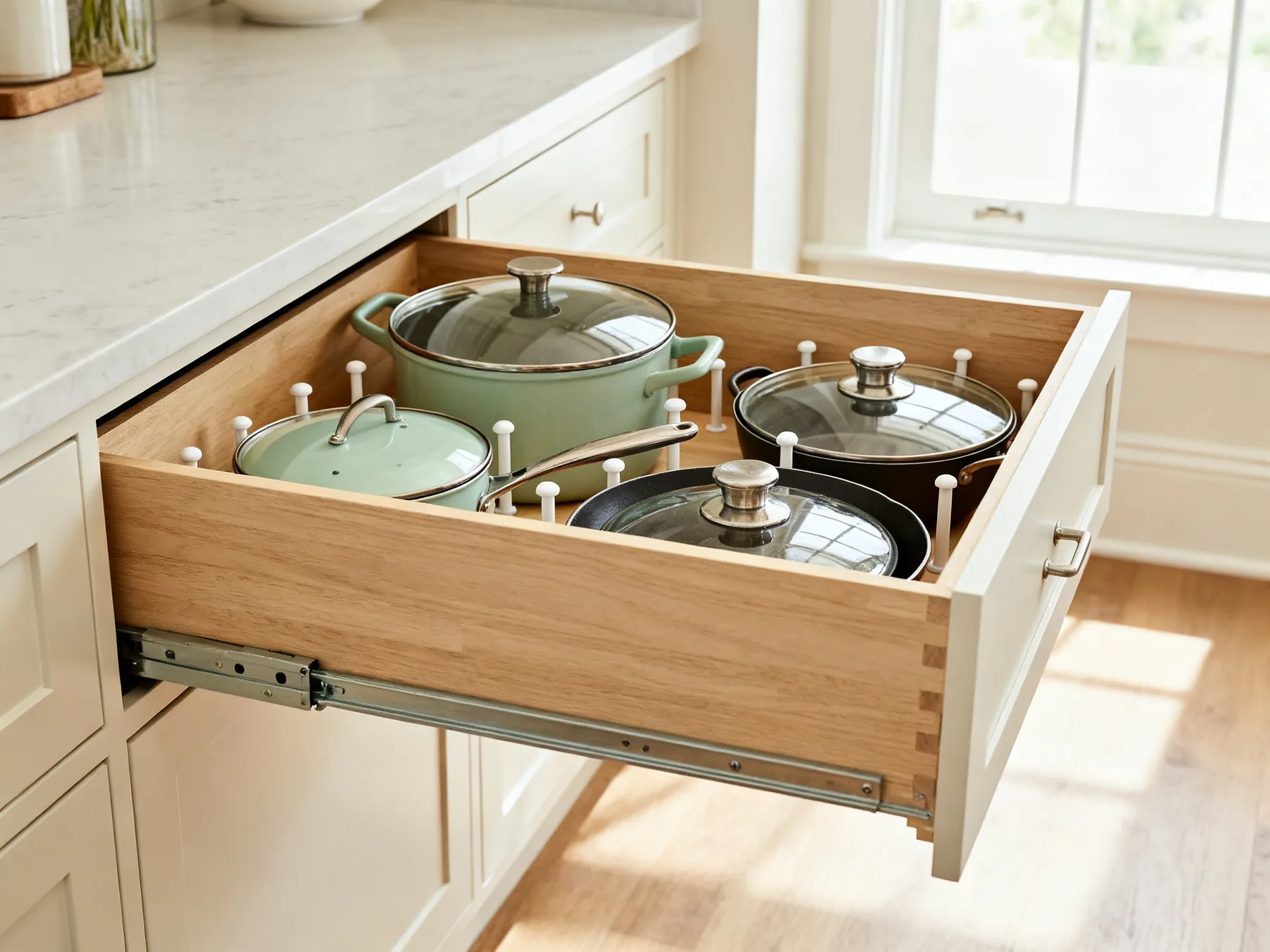
Use deep drawers with adjustable dividers for pans
Pans and lids standing on edge in a divided deep drawer are each individually liftable, and you can see the whole set from above. Stacked in a cupboard you get the top pan and a small avalanche.
Divide the utensil drawer properly
An undivided utensil drawer becomes one mass you rummage through. Compartments sized to what you own, rather than a generic tray, is the difference between finding the peeler and emptying the drawer.
Insist on full-extension runners
Partial runners permanently hide the back third of every drawer, which recreates the exact problem drawers were meant to solve. This is worth paying for.
Put a shallow drawer at the top for the small stuff
Foil, bags, clips, skewers. The things that otherwise colonise a worktop corner. One shallow drawer absorbs a surprising amount of counter clutter.
Use the walls and the doors
This is where the counter actually gets cleared, and it is cheap. The splashback wall, the ends of the cabinet run and the inside of every door are all vertical surfaces doing nothing.
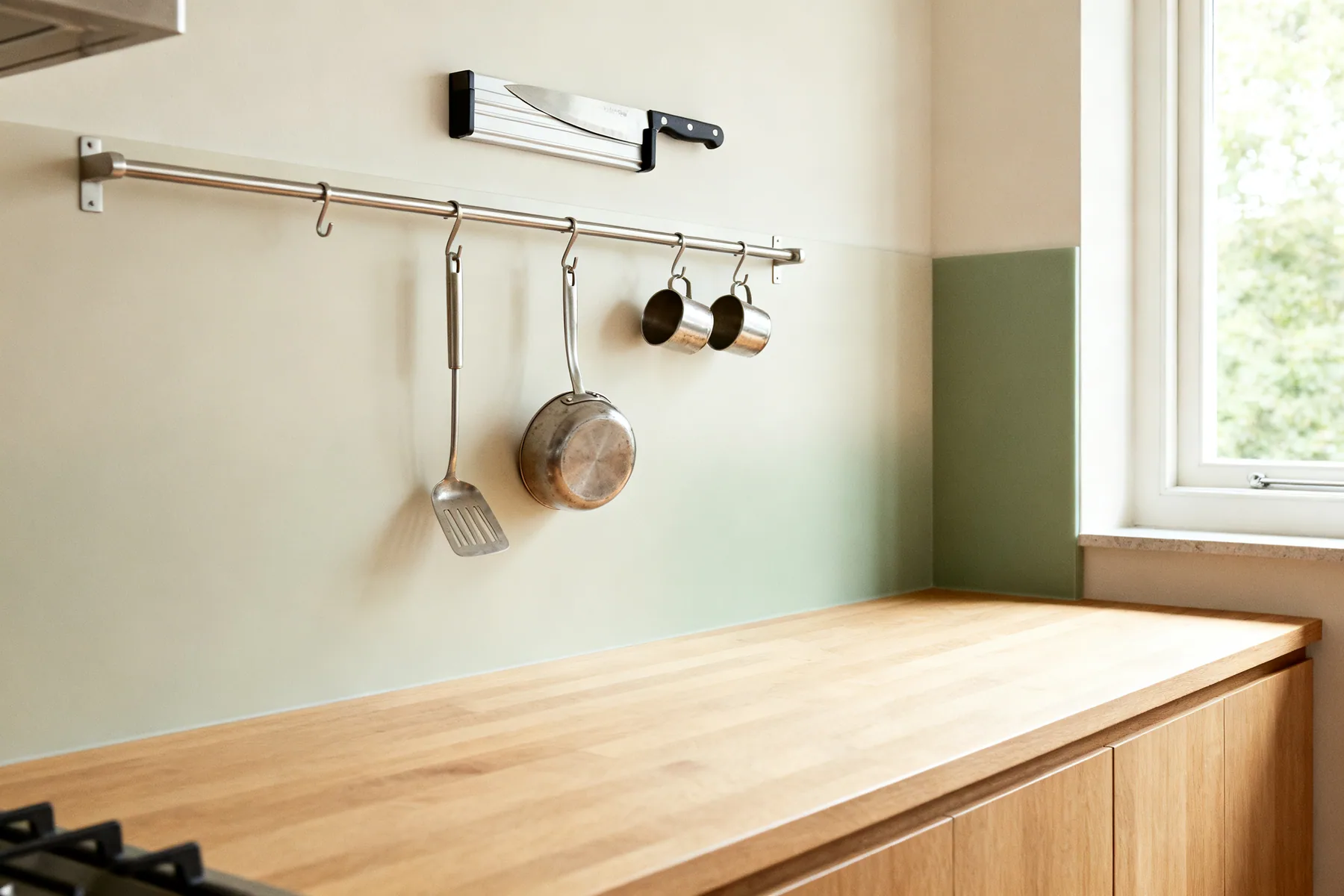
Fit a rail above the worktop
A slim steel rail with S-hooks holds the utensils you use constantly, plus small hooked pots for the things that live in a jar on the counter now. Everything stays within reach and the counter beneath is clear.
Use a magnetic knife strip
A knife block is a large object occupying prime counter. A magnetic strip on the wall holds the same knives, keeps the edges clear of each other, and costs no counter at all. Fix it properly, because it will be holding sharp things at head height.
Put racks on the inside of cabinet doors
Slim wire racks on the inside of a door take spice jars, cling film, small packets and cleaning sprays. Keep them shallow enough that the shelves still clear, which is a tighter margin than it looks.
Hang a rail or hooks on the end of the run
The exposed end panel of a cabinet run is a free vertical surface. Hooks there take tea towels, oven gloves and an apron, all of which otherwise end up over a chair or on the counter.
Consider a narrow shelf under the wall units
A very shallow shelf, around 100mm, fitted under the wall cabinets holds oils, salt and the two things you reach for while cooking, lifting them off the worktop while keeping them to hand.
What should not be in a small kitchen at all
The last part is the one that changes a small kitchen fastest, and it costs nothing. A small kitchen cannot also be the household appliance museum. If the storage is full and the counter is covered, the honest answer is usually that the room is being asked to hold more than it can, and no amount of clever fitting fixes that.
I would rather say so plainly than sell you another rack.
- Move anything used less than monthly out of the kitchen entirely.
- Be honest about single-purpose appliances. The bread maker used twice belongs elsewhere.
- Keep one set of everything. Duplicate utensils fill a drawer faster than anything else.
- Store bulk food shopping outside the kitchen, and keep only what is in use here.
- Decant dry goods into square containers, which use about a fifth more shelf than round ones.
- Leave one stretch of counter permanently empty and treat it as equipment, not as space going spare.
- Reassess the counter every few weeks. Whatever has crept back on has no proper home yet.
Small kitchen storage ideas that give you your counter back: frequently asked questions
How do I get more storage in a small kitchen?
Start with the band above the wall cabinets, which is usually 300 to 500mm of unused wall running the full length of the kitchen, and fit a second tier of doors into it. Then fix the corner base cabinet with a pull-out, because that is where most wasted volume in a kitchen sits. Both add real capacity without touching the layout.
Why does my small kitchen feel cluttered even when it is tidy?
Because the counter is doing storage duty. In a small kitchen clear worktop is your working area, so anything living on it permanently is taken out of the space you cook in. Getting the daily tools onto a wall rail and a magnetic knife strip, and the small items into a shallow top drawer, changes how the room feels more than any cupboard will.
Are drawers or cupboards better in a small kitchen?
Drawers, for almost everything and especially anything heavy. A drawer brings its whole contents out to you, while a base cupboard makes you kneel and reach past the front row, so the back half tends not to get used. Use deep drawers with adjustable dividers for pans and insist on full-extension runners.
What is the most wasted space in a kitchen?
The corner base cabinet. The opening is on one face while the cabinet extends in two directions, so there is a zone at the back you can neither see nor reach without unpacking the front onto the floor. A swing-out or carousel pull-out brings the whole corner out into the room and can usually be retrofitted.
Should I store things on top of my kitchen cabinets?
It is much better than leaving that space empty, but use matching lidded boxes rather than an assortment of objects. Lids handle the grease and dust that collect up there, and one repeated container shape reads as deliberate while six mismatched things read as clutter. Boxing the gap in with doors is better still if the budget allows.
How do I stop the kitchen counter filling up again?
Anything that lands on the counter repeatedly does not have a home yet, so treat it as information rather than as untidiness. Check the counter every few weeks, and for each item that has crept back, decide where it actually belongs: a wall hook, a shallow drawer, a door rack, or out of the kitchen altogether.