Closets, Halls & Garages
Garage storage ideas: how I get the floor back
A garage never runs out of space. It runs out of walls being used. Nearly every one I walk into stores everything on the one surface you also have to walk across.
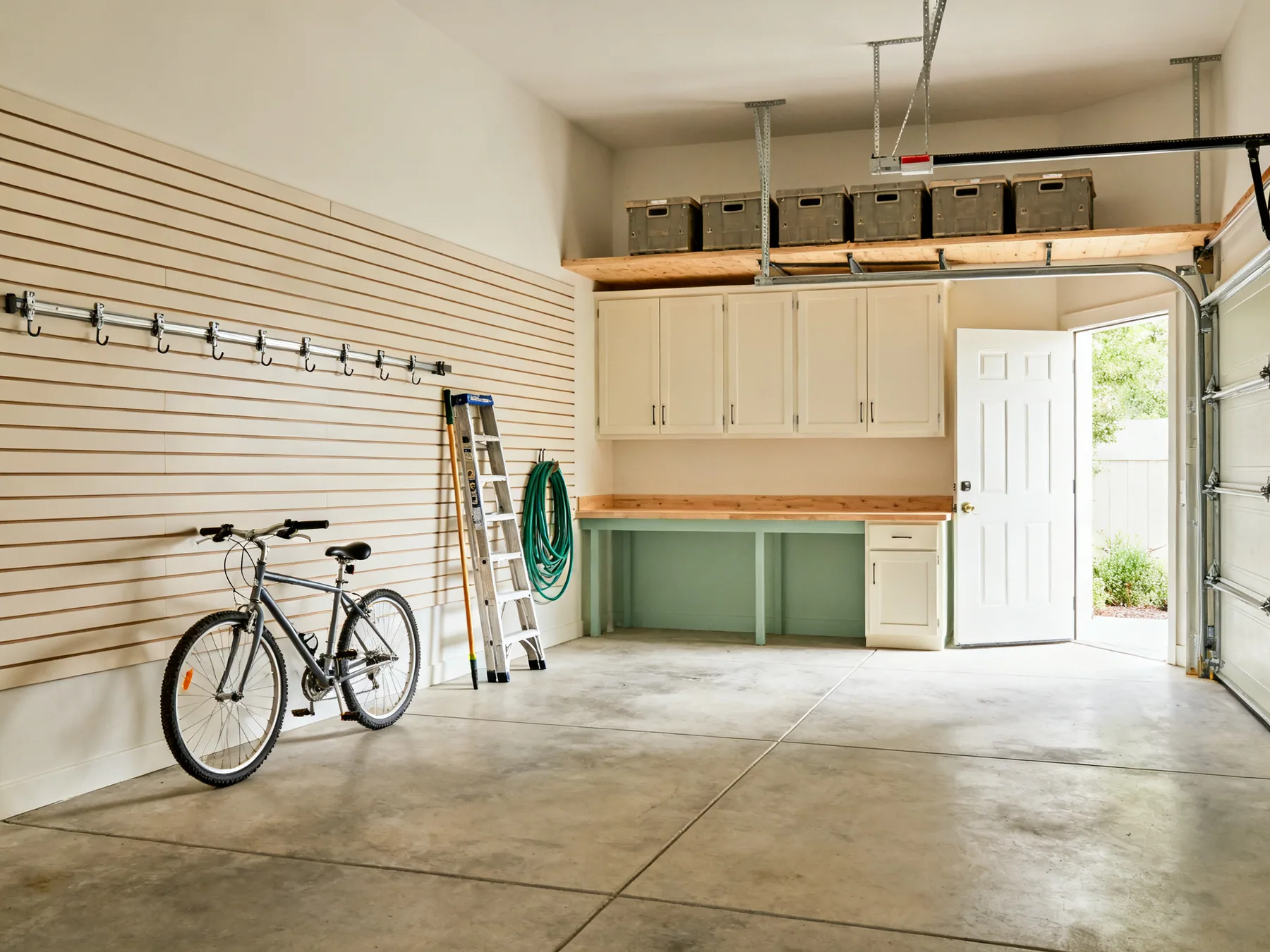
A single car garage gives you about 18 square metres of floor and roughly 45 square metres of wall, plus a ceiling nobody looks at. When a garage has become impassable, almost always the 18 has been used and the 45 has been ignored. That is the whole problem, and it is the whole solution.
The other thing I would tell you before you buy anything: this is a sequencing job, not a shopping job. Everything comes out, the walls go up, then things go back in a deliberate order. Buy the storage first and you will buy the wrong storage, because you do not yet know what you are storing.
Everything comes out before anything goes up
I know this is the part people want to skip. It is also the part that decides whether the result lasts, because a garage is not one storage problem. It is five or six unrelated ones sharing a room: the car, tools, garden equipment, bulk household goods, recycling, sports kit. They have completely different access needs and mixing them is why the space became unusable.
So everything comes out onto the drive, and then I walk the empty space and give each wall a single job. Garden tools go nearest the door to the garden. Bins go nearest the driveway. Car things go beside where the car actually sits. Once each wall has one purpose, most of the decisions make themselves.
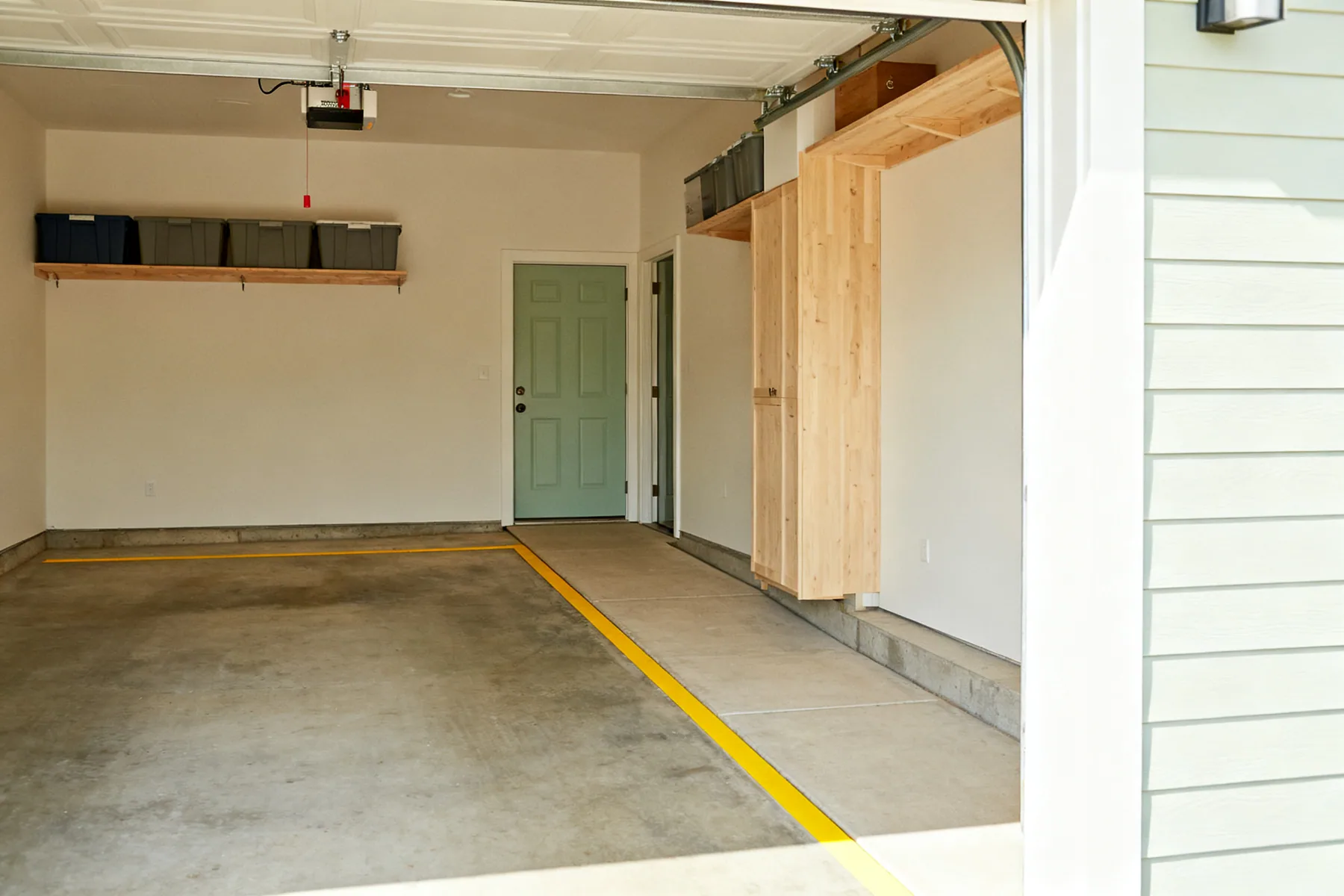
- Mark the car footprint on the floor with tape, including room to open the doors.
- Mark the 600mm walkway you need from door to door and keep it permanently clear.
- Give each wall one purpose: tools, garden, sports, bulk.
- Put anything used weekly between 750mm and 1.6m off the floor.
- Keep above 2m and the ceiling for light seasonal things only.
- Anything that is not garden, DIY or car related probably does not belong in here at all.
The walls are where the capacity is
This is where the space you are missing actually lives. There are three systems worth considering and they suit different budgets and different tool collections.
One thing I want to be blunt about, because it is the most common and most dangerous mistake I see: fix into the studs or into masonry. Not into plasterboard. A track rail loaded with tools that pulls out of plasterboard comes down all at once, and it comes down on whatever is below it.
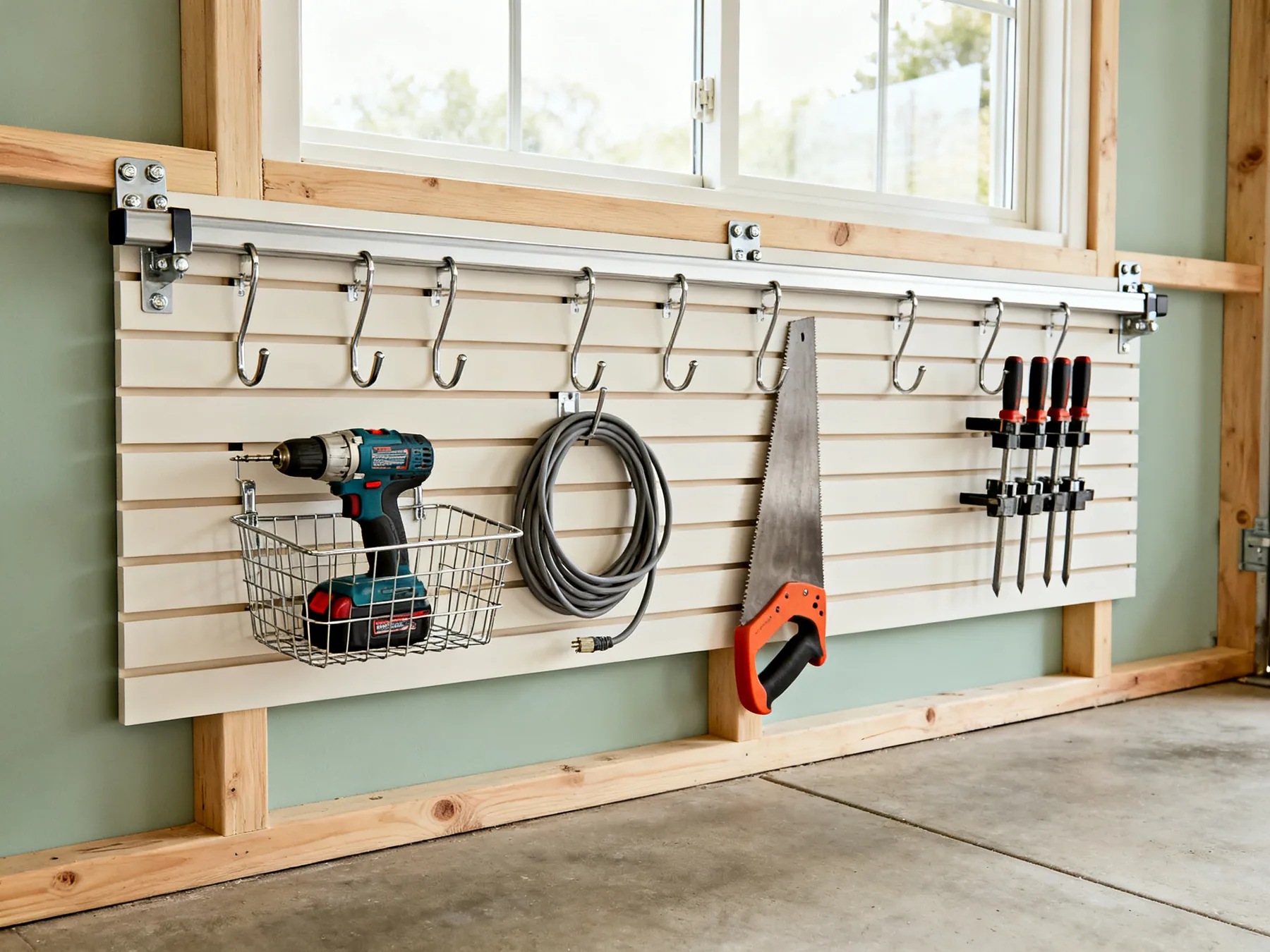
Install a slatwall or track system
Horizontal grooved rails screwed into the studs, with hooks and baskets that clip in anywhere along them. It rearranges in seconds, carries real weight, and handles long handled tools properly. If you are going to use the garage for years, this is the one I would spend the money on.
Fix into studs or masonry, never plasterboard alone
Use pegboard for small hand tools
Cheap, dense, and instantly readable, which matters because with small tools finding it is the actual problem. Spanners, screwdrivers, pliers, clamps. Mount it on battens so the pegs have clearance behind. I would not hang heavy power tools on it.
Build a French cleat wall
Bevelled timber rails at 45 degrees with matching hooks and shelves you make yourself. Very strong, very cheap in materials, and endlessly adjustable. It takes a weekend and a saw, and it is genuinely satisfying if you enjoy that sort of thing.
Put a run of closed cabinets along one wall
Closed doors keep dust off anything precision or chemical, and they stop the garage reading as visual chaos, which matters more than people expect. Wall hung units keep the floor underneath free for a bench or the bins.
Long handled tools: one rail, a third of your floor back
If you do one thing from this page, do this one. Spades, rakes, forks, brooms and strimmers stored leaning in a corner will fall over, they will tangle, and the handles rot from the bottom because they are standing on damp concrete.
A single horizontal rail at about 1.6m with spring grips holds the lot upright and clear of the floor. In most garages I do this in, it recovers something like a third of the usable floor on its own, and it takes about twenty minutes.
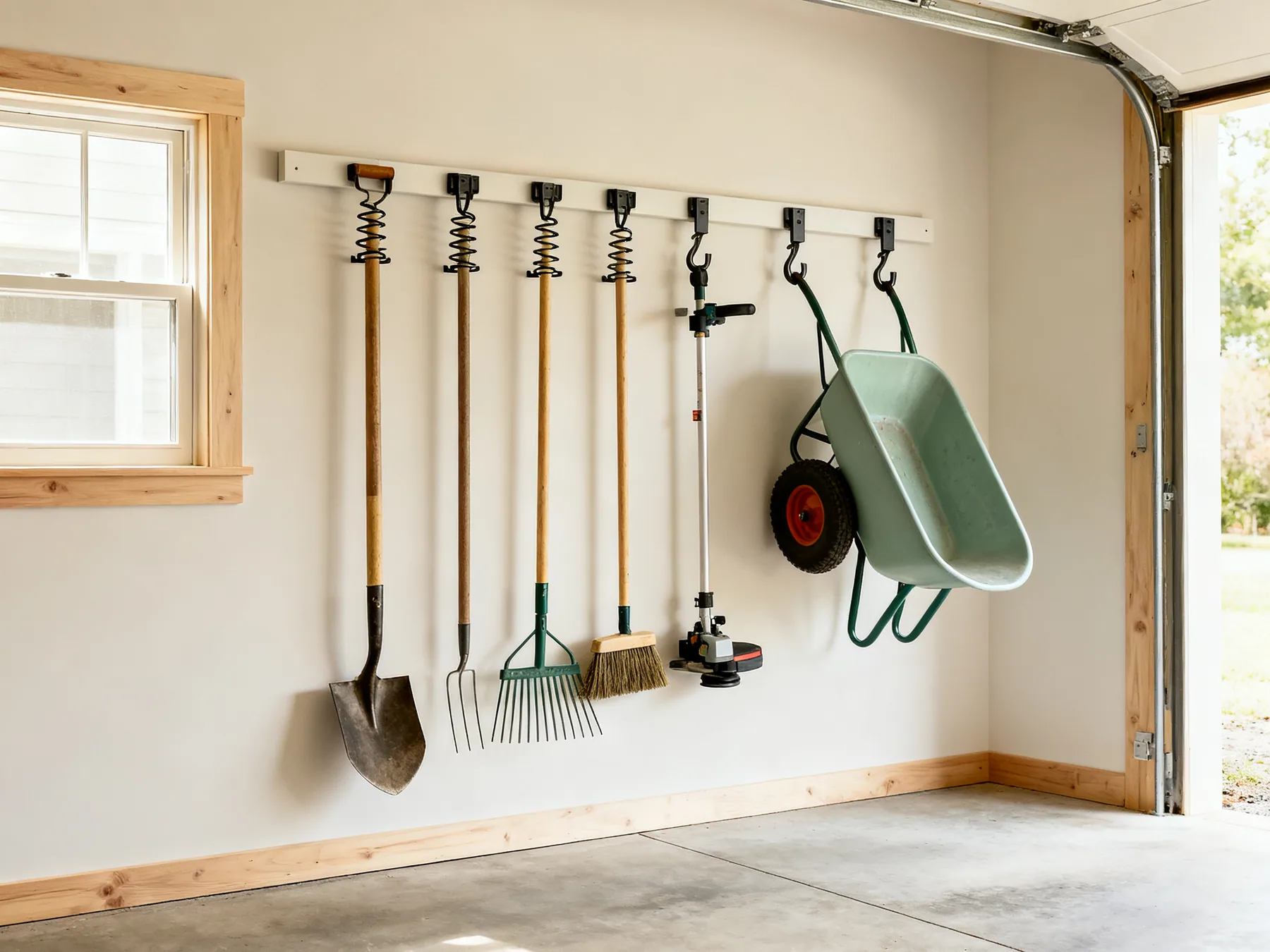
Hang the wheelbarrow vertically
A barrow on the floor eats the best part of a square metre. Hung by its front lip on two heavy hooks it takes almost nothing. Fix into a stud, because a barrow is heavier than it looks and it swings when you lift it off.
Coil the hose on a wall reel
A hose on the floor is a trip hazard and it kinks permanently where it lies. A wall reel into two studs solves both. Drain it before winter, because trapped water splits a hose when it freezes.
Give powered garden tools two hooks each
Strimmers and hedge trimmers have awkward shapes and vulnerable cutting heads. Two hooks per tool, head upward, keeps the blades clear of everything and the cable coiled rather than trailing.
Overhead storage, and the mistake that makes it dangerous
The ceiling is genuinely free space in almost every garage. It is also the easiest place to create a hazard, so there are three things I check every time.
First, the fixings go into the joists with the bolts the manufacturer specifies. Second, I establish where the garage door sits when it is fully open, because an up and over or sectional door travels back along the ceiling and it needs its track and springs clear. Third, and this one people argue with me about: nothing goes directly above where the car parks. Anything stored above a car will eventually end up on the car.
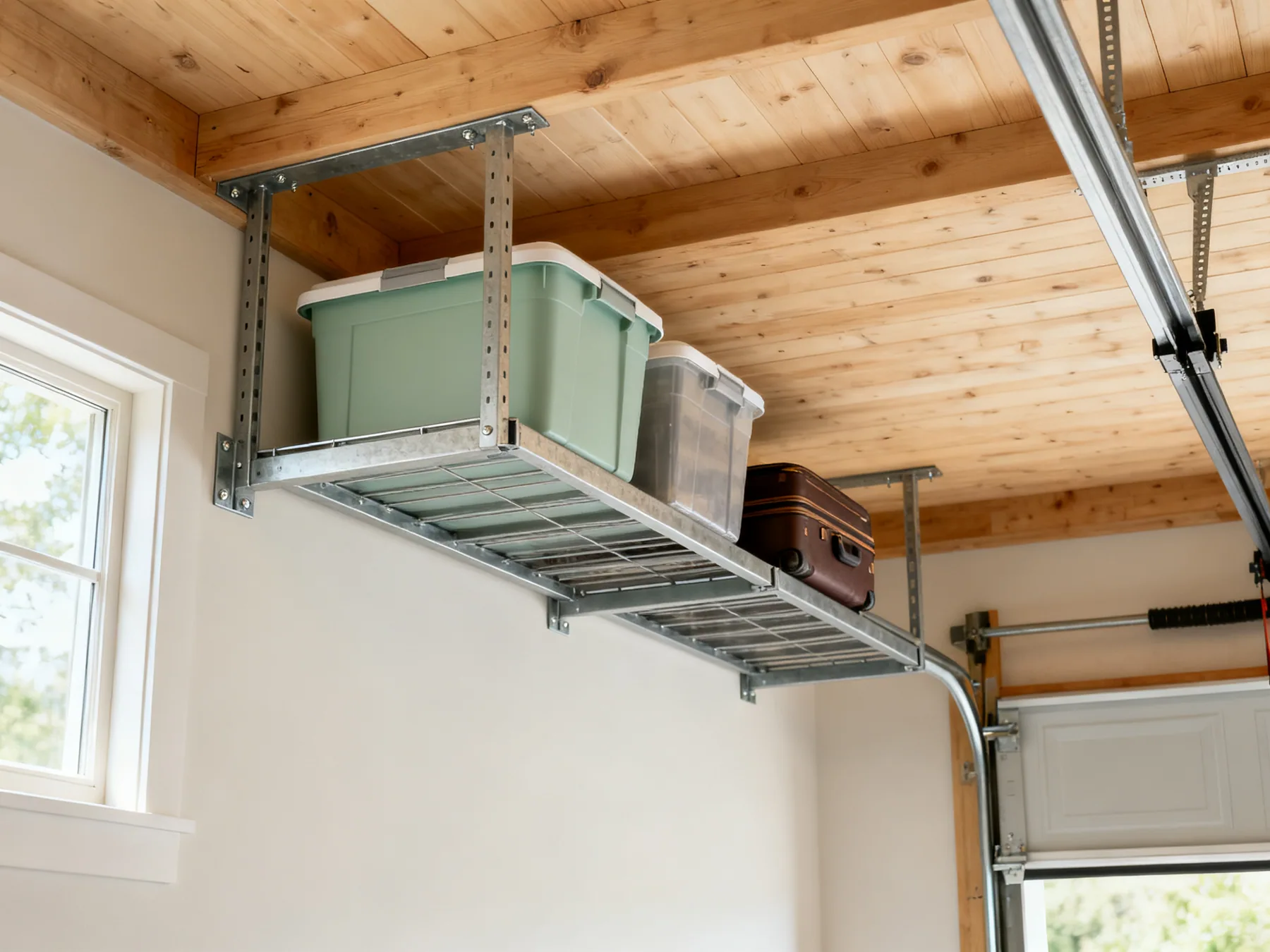
Fit racks between the joists at the perimeter
Ceiling mounted platforms hold something like 100 to 300kg depending on the model and the fixing. Use them for the classic bulky but light category: decorations, camping gear, luggage, spare bedding. Route them around the edges of the garage, not over the parking bay.
Use a hoist for bikes and kayaks
A pulley hoist lifts something awkward out of the way on one rope, usually rated around 20 to 50kg. Good for things too unwieldy to lift onto a rack. Poor for anything you use weekly, because the effort per use is too high and you will stop bothering.
Keep monthly items off the ceiling entirely
Access effort should match how often you need something. If you are getting the stepladder out to reach it, it had better be something you touch once or twice a year.
Storing the specific awkward things
Bikes: hang them vertically by the wheel
A vertical wall hook holds a bike in about 400mm of wall, against roughly 1.7m of floor if you lean it. With several bikes, stagger the hanging heights so the handlebars do not clash.
Tires: on a rack, on their sides, off the concrete
No more than four high, on a rack rather than straight onto concrete, away from sunlight and away from electric motors because of the ozone. Standing them on the tread for months flat spots them.
Timber: flat and supported, or it bows
Timber leaned against a wall takes a permanent bend. Support it flat on brackets at 600mm centres, or vertically in a rack if the pieces are short, and keep it off the floor where damp wicks up into the end grain.
Sports kit: one open bin per sport
Balls, bats, pads and helmets get thrown back rather than filed, and no system survives that except an open bin. It also lets damp kit dry, which a sealed box does not.
Garden chemicals: locked, cool, off the floor
A lockable cabinet, out of direct sun, and raised in case something leaks. Check the label for a minimum temperature, because plenty of products are ruined by freezing and an unheated garage will get there.
What I will not let people store in a garage
An unheated garage is damp in spring, hot in summer, below freezing in winter, and unventilated most of the time. That swing ruins a specific list of things, and a couple of items on it are a genuine safety matter rather than a preference. This is the part of the conversation where I get the most pushback, and it is the part I am least willing to bend on.
- Water based paint. Freezing destroys emulsion and it cannot be recovered. Keep it indoors above 5C.
- Propane cylinders. Never in an attached garage or any enclosed space. Leaking gas is heavier than air and pools at floor level. Check your local rules, which usually say this explicitly.
- Petrol. Approved container only, smallest quantity you need, nowhere near a boiler or any ignition source.
- Lithium-ion batteries and power tool packs. Heat and cold both shorten their life and raise the fire risk. These come indoors.
- Paper, photographs and documents. Damp and temperature swings destroy them, and there is no undoing it.
- Bedding and soft furnishings, unless they are in sealed hard containers. Otherwise they absorb moisture and attract rodents.
- Tinned food. Repeated freeze and thaw can compromise the seals.
How to stop the floor filling up again
Every garage I have reorganised that later went back to chaos went back for the same reason: the floor had space with no assigned purpose. Give any floor area no job and it becomes a shelf.
The fix is almost stupidly simple. Mark the car bay and the walkway with floor tape, and treat those areas as though they were solid. Once every item has a defined wall or overhead home, anything sitting on the floor is visibly out of place, and that is what keeps it clear. It is not discipline, it is just making the wrong thing obvious.
Garage storage ideas: frequently asked questions
What is the best garage storage system?
For most garages a wall track or slatwall system fixed into studs or masonry. It carries real weight, handles long handled tools, and rearranges in seconds as your needs change. Add pegboard for small hand tools where quick visual identification matters, and overhead racks at the perimeter for light seasonal bulk.
How much weight can garage overhead racks hold?
Typically 100 to 300kg depending on the model, but only when bolted into the ceiling joists with the fixings the manufacturer specifies. Into plasterboard alone it is unsafe at any load. Use them for bulky light items like luggage and decorations rather than anything heavy or anything you need monthly.
Can I store paint in the garage?
Not in an unheated one. Water based emulsion is ruined by freezing and cannot be recovered, and most paints specify storage above 5C. Keep it in a cupboard indoors. If you have no choice, keep it off the concrete floor and against an internal wall, and accept you may lose it.
Is it safe to store a propane tank in the garage?
No. Propane cylinders should not be stored in an attached garage or any enclosed space, because leaking gas is heavier than air and pools at floor level where an ignition source may be. Store cylinders outdoors, upright, ventilated and shaded, and check your local regulations, which usually address this directly.
How do I stop my garage floor filling up again?
Mark the car bay and a 600mm walkway with floor tape and treat both as unavailable. Once every item has a defined wall or overhead home, anything on the floor is visibly out of place, which is what actually keeps it clear. Floor space with no assigned purpose always fills.
Where should I start with a garage that is completely full?
Empty it onto the drive. It sounds excessive and it is the step that makes the difference, because a garage is several unrelated storage problems sharing one room and you cannot see them while everything is stacked. Then give each wall a single purpose before you buy anything.